Strength Of Tears Blog

  • How To Develop Easy Strategies For Coping With Anxiety
    How To Develop Easy Strategies For Coping With Anxiety

    How To Develop Easy Strategies For Coping With Anxiety

    How To Develop Easy Strategies For Coping With Anxiety – Learn how to prioritise and calm your mind and focus on less

    Do you find your anxiety getting in the way of your life?

    If you’re anything like me then life on lockdown has brought all the thoughts and feelings of overwhelm crawling out of the shadows and interrupting your plans. That’s if your plans could be any more interrupted from most of the world being on lockdown.

    However, I have absolutely no intention of increasing those feelings of overwhelm, anxiety and panic that you’re probably trying to get away from right now, but it’s hard not to mention it, right?

    You’re a mum. You’re living with chronic illness or mental health problems. You may even be shielding. You may be living in a small space and feeling a lack of personal space. Life might just be full on, crazy, arghhh. 

    You may be worried about family you can’t see and so much more that it’s no wonder you’re feeling overwhelmed. But you know what, it’s okay not to be okay. If you feel the need to cry, cry. If you feel like curling up under the duvet right now, do it! Yours and your family’s well-being is all that’s important right now.

    If I was to recommend something to help with the stress than I find lavender an extremely useful oil to use when I’m anxious. My preferred way of using this at any time of day or night is to have this Neal’s Yard Calming Temple Salve to hand.

    But that’s the last reference I’m going to make to the C word. I’ll be focusing on overwhelm, anxiety and panic generally and what can contribute to these feelings. I’ll cover how you can limit the impact of these feelings on your everyday life and most importantly set you up with a plan for how to cope, when it does.

    By the end of this blog you will:

    • Understand why our body reacts to stress in the way it does

    • Have a way of making sense of your feelings of overwhelm

    • How to limit the impact of overwhelm on you and on your family

    • Have a plan to cope with anxiety when the unexpected happens

    * Disclaimer – this blog post contains affiliate links. Any purchases made through these links will give me a small monetary reward, without any cost to you. I only recommend products I genuinely like and use.

    Why does our body react to stress in this way?

    Stress is the body’s natural way of protecting us from harm. The brain reacts to stress in the same way it would have reacted to the threat of danger, when we were primal beings. The brain can’t tell the difference between real danger or not so our bodies react, which can be very scary. 

    Our brain gets confused so sends signals to our body that we’re in danger. Our heart rate increases, we breathe faster and are on high alert. This is known as the primal fight or flight response and it’s something we all experience, but in differing degrees. 

    At first our body may respond with a feeling of worry but this can increase to anxiety or panic attacks. We may sweat, feel dizzy, tense up or get fidgety. We can get stomach aches and even feel sick. It can be very unsettling and we may not know what to do.

    My advice is always to listen to your body, but to do that properly here you need to understand why it’s happening.

    Don’t let your mind bully your body into believing it must carry the burden of its worries

    — Astrid Alauda

    The Science Bit: 

    Every thought releases chemicals, so when we’re feeling happy or optimistic, cortisol levels decrease and our brain produces serotonin. This makes us feel less anxious and creates a feeling of well-being. However when the stress response occurs, the brain sends signals to the adrenal glands which pumps out cortisol, putting us on high alert and ready to fight or flee.

    To know what we need to do from here we need to dig a little below the surface and really consider what is making us feel like this. So I’m going to give you the tools to be able to work out what is going on for you. Obviously, this will be in the form of self help exercises. If you notice a worsening feeling whilst doing these, please stop and seek professional help.

    How you can make sense of your overwhelm

    I’ve dealt with overthinking, overwhelm and high anxiety levels since I became a mother. I’ve always been an overthinker but caring for small humans increased that, as I was on high alert from the pressure to do it all right, but also that primal need to protect my young. 

    I think many new mums go through this, in fact I still have this need to protect and my boys are teenagers now! Of course, we all experience this differently and the way I deal with overwhelm depends on the situation. However the journey I’m going to take you on now, uses a method that works for me most of the time.

    As a mum, you’re probably also dealing with other stresses in life, such as a trip to the supermarket, being stuck at the traffic lights at pick up time or sharing a few cross words at home. There will be other things lying around with these possible low level stressors right now but any of these are going to tip the balance.

    The Stress Scales Exercise – Part 1

    These stressors can be stuff at home, work, family, relationships or all of the above. Use this exercise to get stuff out of your head and get some breathing space. Just to be clear this isn’t the stress scale that psychologists use, it’s simply placing everything that’s going on in your mind into a visual you can work with

    Step 1

    I want you to imagine a set of old-fashioned scales. One side holds all the things that make you feel happy, calm, love and optimism. On the other,  I want you to imagine the things that are making you feel stress, anger, disrespect and negativity. These are your life balance scales, including everything in your life now.
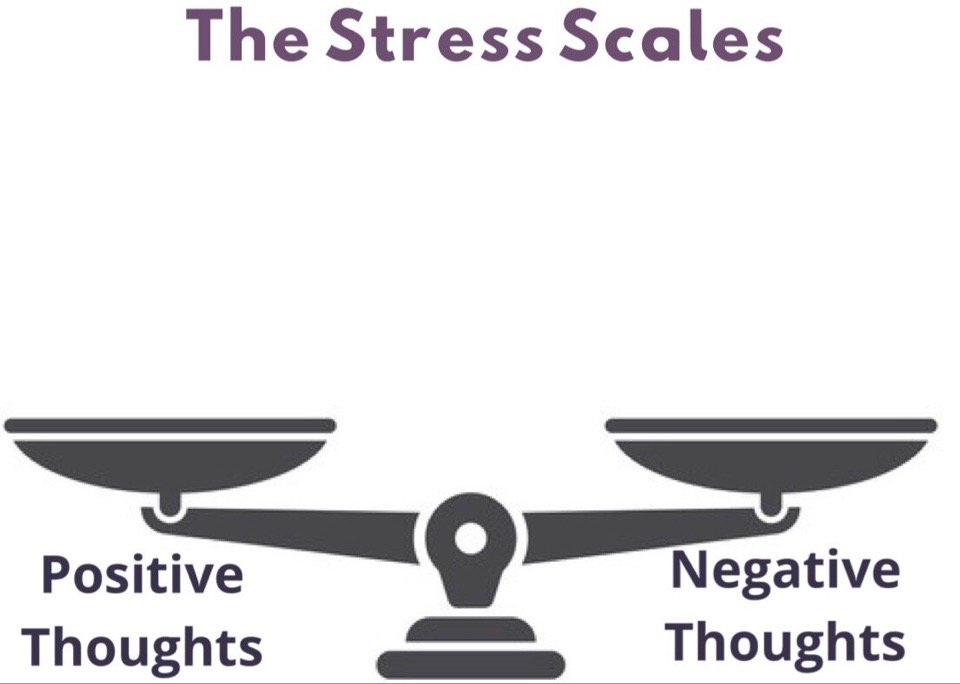
    Download a PDF here to write or draw on or use a plain piece of paper.

    Once those scales have been tipped it’s going to take work to get back the balance you need to function well. You may be wondering how you go about this. You can’t help getting stuck in traffic jams or having work deadlines, right? Of course not, so you’re going to choose to take on something that you can control. 

    Step 2

    I want you to prioritise everything that’s been swirling in your mind and is now weighing down one side of those scales. I use the visual of stress scales as a simple way you can start to understand your overwhelm. You can write or draw, if you’re artistic, a simple representation of how your feelings are affecting your life. 

    You will need some coloured pens or pencils
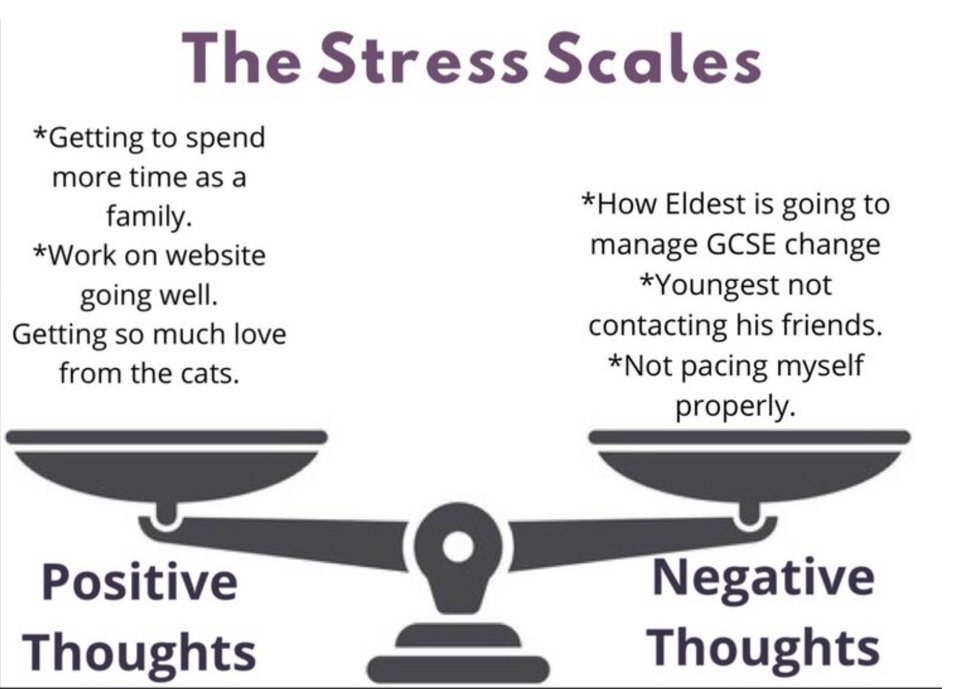
    This is my example

    Put everything on your mind, that makes you feel happy and calm on one side of the scales. On the other, the things that are causing you any stress, negativity or even anxiety. Let this be a brain dump exercise. Getting all of the things that are playing on your mind down on paper often helps limit the impact on us. 

    Take a moment to consider if anything is missing from your image. This is an activity you can repeat regularly and whenever you feel the need to reassess. 

    Making a plan to limit the impact of overwhelm on you and on your family

    The simple exercise of getting your feelings down on paper begins the process of working through your feelings. Sometimes we try and bury the negativity or the pain. Whereas focusing on these feelings starts the process of working out what’s causing the majority of your overwhelm.

    When you know what your negative thoughts and feelings are, you can begin to take gradual steps towards making everything more manageable. Please take the next part of this exercise one step at a time. The worst thing you could do would be to allow these feelings to take control. Ask someone to help you if you need it.

    Step 3

    Now you have this visual representation of your stress, read what you’ve written or drawn. Maybe you notice a pattern in the mix. What is most urgent? What keeps getting pushed back to another date because of the urgency of work deadlines? Take as much time as you need to reflect on this.

    I believe that we can cope better with stressors when we push forward the importance of those things that make us feel happy. This goes back to the science of what happens in the brain when we think positive thoughts. So is there something you could do more often from your positives? Maybe this could be one of your priorities?

    Step 4

    Now look at the list of stressors in more detail and start to prioritise. My advice here is to prioritise as little as possible, whether it’s things at work or home. The reason for doing this is so you can take back control of as much of life as you can.

    How to make the choice of what you prioritise? 

    This is the difference between what’s urgent and what’s important. It’s easy to confuse and get overwhelmed and create a big list. This is about taking that away and finding the one thing you need to do now. 

    Start by using coloured pens (of your choosing) and make a note of:

    • A few things that are top priority (can be 2 colours)

    • Things that you have to do now

    • Things that you can do later

    • Things that you don’t need to do at all

    • Things that need to be done on a regular basis

    Now everything is colour coded, look again at what you’ve prioritised. I find it really important to reflect regularly on whether expectations are realistic. Have you prioritised using your own expectations of yourself or expectations put on you by others?

    Step 5

    Work out what you can control out of those higher priority tasks. Finding things we can control helps us feel less overwhelmed and can lessen the feelings of anxiety. This should narrow down your list. If you’re putting that pressure on yourself, is it a vital task? Can that job be left for a bit longer without causing problems. 

    Once you’ve done that you can prioritise one of these tasks that you have to do now but are also important for your well-being. We all cope differently with stressors so this is something you need to think through yourself. 

    If something work wise is weighing heavily and only you can do it, then it’s priority. Or if your toddler is constantly drawing on the walls that you’ve just painted, then that might be what’s stressing you out the most. You can even make a pros and cons list here if you really can’t decide.

    Choose just ONE of these priority tasks.

    Step 6

    The next step is to create small goals to work with as this is easier for your brain to cope with than a large, final outcome. For example: you have to deal with your child being rude to you when they come off of the Xbox. What do you want to achieve? What does the finished outcome look like? Work backwards from here.

    Create 3-4 steps you need to put in place to reach the outcome. Start with a small step by looking closely at what’s going on. What will be the least stressful set of actions? The last thing you want is more stress. Write the goals in positive language, for example, ‘I will respond to rudeness by taking a deep breath and counting to ten. 

    Ask yourself these questions: 

    • Is the overall outcome realistic and achievable? 

    • How long will it take to get there? 

    • Do the steps to get to the end point make sense?

    • What help will I/We need to meet each small goal?

    Step 7

    Finally, go back to that list of things that make you happy. For me this is family time or spending some time pampering myself. Go back to each of the steps for your goal and place a reward for when you achieve the goal, using the things that make you happy. It could be a bubble bath or a family picnic on the lounge floor. 

    You can save the best reward for the final outcome. If your goal involves someone else’s behaviour then be sure to reward them too. It could even be something you haven’t got on your scales now but want to. 

    The idea of this exercise is to find the balance so that you can move those things over to the other side of the scales and feel like you have control over the things you need to do. I find that one long list of things to do isn’t helpful for my mindset. By breaking it up like this you can get a clearer image of what you need to do.

    If we are stressed out, we won’t be ‘joyful mothers of children.’ Balance is key

    — Katherine Leigh

    How I cope with anxiety when the unexpected happens

    I don’t know about you but when the unexpected happens I get thrown. It can be as simple as my routine changing or seeing a friend at the last minute. I know that sounds off, don’t get me wrong, I love being with friends, even via video call, but it can leave me feeling like I haven’t achieved what I’d planned for the day. 

    This used to be really stressful for me. However, I’ve developed a system in my planner so that I can carry things over to another day, week or even month. This goes back to my priorities, Is it more important to be with my children or clean out that cupboard? Again, this is a very personal thing but it helps.

    Using a journal is a wonderful way to record your feelings, write daily intentions and reflections. These actions will become a healthy habit and this will help you think more positively about situations or work through strong emotions during a huge life event.

    I said before that most of the stress I feel is because I expect so much of myself. It wasn’t until we had family therapy and my boys felt able to tell both Joel and myself that we should give ourselves a break, that I really noticed. They were in upper primary school, but their words meant a lot to us both.

    Now I remind myself of all the small things I’ve achieved each day, whether they’re part of my priority goal or not. I write down the things I’ve achieved or am pleased about in my journal. I do this every day, even on the bad days, I try my hardest to find the small wins as this helps me think positively, reducing my anxiety levels.

    If your anxiety is severe and you suffer from flashbacks then this self help article from getselfhelp.co.uk explains how grounding techniques can be used to bring you into the present if you suffer from distress and trauma. However, please seek medical advice if you feel you need help with your feelings right now. 

    Developing Coping Strategies For Anxiety That Work For You

    But what happens when all these little things fail? You’ll need something to fall back on that you know works and is tried and tested. If you are looking for something to help you when the unexpected happens then I recommend reading this blog I wrote about Meditation For Well-being.

    However, there are other, simple exercises called grounding techniques that can help get you back on track when you feel out of control, anxiety or panic. They are easy to use when you feel overwhelmed, anxious or even during a panic attack. 

    If you just can’t wait, grab my free easy grounding techniques guide now. Click here to download this guide to help you develop your own coping strategies for living with invisible illnesses. 

    I believe that having support on your journey to coping with chronic illness and everything that comes with it, is priceless. This blog skims the surface of this topic but it’s the perfect start for tackling the stress you’re feeling right now by finding strategies that work for you. 

    What Are Grounding Exercises?

    Grounding exercises are calming strategies you can use as a simple way to calm you when you’re suffering from anxiety or panic attacks. They help you keep your mind and body working together, making you focus on the ‘here and now’, to ground yourself when everything’s getting too much. 

    When you’re feeling overwhelmed, being able to connect your mind and body using your senses, brings you into the present. This helps you to break patterns that lead to the anxiety or panic attacks. They can be as simple as breathing exercises or as structured as a traditional meditation.

    I’ve created a quick guide to grounding exercises where I share my top 5 techniques and easy tips to help you learn them off by heart so you can access them more easily when you’re experiencing fear or anxiety. You can get this guide by signing up to my email at the bottom of this page.

    I recently shared one of these grounding exercises on social media and it helped so many people that I’ve decided to share it here for you ⬇, it’s also in the guide. This gives you a taster of how packed full of value, my newsletter will be for you.
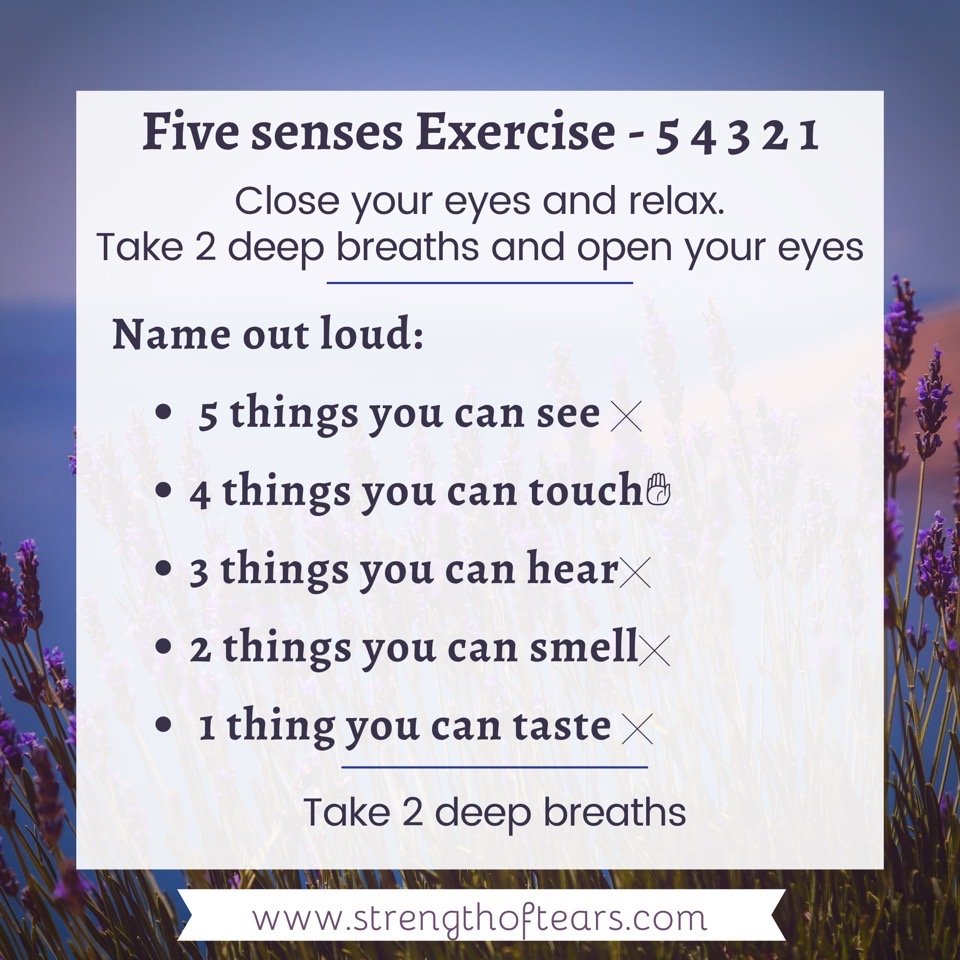
    5 senses exercise – 5 4 3 2 1

    This 5 4 3 2 1 grounding technique is great for children too. Check out this article from Coping Skills For Kids. It explains this exercise very clearly. I’ve also set up my free guide with fun ways to learn this and the other techniques, most suitable for children. I know that these exercises would have helped Eldest when he was fighting severe anxiety.

    The Takeaway

    Firstly, if you can understand why our body reacts to stress the way it does, you can rationalise it. When you feel overwhelmed, it’s okay to feel like you’re out of control and it’s normal to feel that drop in your stomach and your heart racing. Remind yourself it’s your brain sending signals to your body to protect you from fear.

    Finding a way of making sense of your feelings of overwhelm and stress is so important. The stress scales exercise I’ve shared with you might not be for you. However, finding the patterns is often the first step towards limiting the impact of overwhelm on you and on your family. 

    This will be different for everyone and probably different for you in different situations. Once you’ve prioritised your needs and the needs of your family, you can look at those patterns and create a plan to help put you back in control. Remember that we all have days when our systems don’t work. 

    Please remember that it’s okay not to be okay, especially right now. You may find that you need to put everything away and snuggle in pyjamas watching TV all day. You may find that organising and sorting helps keep you distracted. Whatever it is that suits you, you need a plan for coping when things don’t go to plan. 


    I’ll share more with you soon but if you need support please email at strengthoftears@gmail.com and I’ll see if I or someone I know, can help you.

    Stay safe, 

    Laura 💜

    P.S. If you need more support with anxiety showing up when the unexpected happens, then please grab your free copy of my ‘5 grounding techniques you need for coping with anxiety’ guide. These exercises have helped me so much and they are so easy to learn.


    ✋ Hey there! I hope you’re feeling stronger now. If so, sharing the love will help me help other mums with chronic invisible illnesses.⬇  Hit one of those sharing buttons or save the images to Pinterest and I will do a bed-bound happy dance – there’s an image for you! 
    #block-yui_3_17_2_1_1586272270979_128386 .sqs-gallery-block-grid .sqs-gallery-design-grid { margin-right: -20px; }
    #block-yui_3_17_2_1_1586272270979_128386 .sqs-gallery-block-grid .sqs-gallery-design-grid-slide .margin-wrapper { margin-right: 20px; margin-bottom: 20px; }

  • 10 Wonderful Ways To Celebrate Mother’s Day At Home

    10 Wonderful Ways To Celebrate Mother’s Day At Home

    10 Wonderful Ways To Celebrate Mother’s Day At Home

    Mother’s Day is celebrated at different times around the world. In the UK we celebrated on Sunday 22nd March in 2020 but elsewhere, Americans, Germans and many other countries are celebrating this May.

    When I wrote this blog the UK was on the brink of lockdown and it had a huge impact on our normal traditions. It’s still going to be a very different type of celebration for countries celebrating this may, still affected in some way.

    In the UK and Ireland, Mothering Sunday has been celebrated on the fourth Sunday of Lent since the 16th century. It was traditionally a day to visit the church where people were baptised.

    However Mother’s Day celebrations date back to the ancient Greeks where they would celebrate Rhea, the Mother of the Gods and Goddesses every spring. The Romans also celebrated a Mother Goddess, named Cybele.

    In 2020, Mothering Sunday is a very different affair as we’re in the midst of an unprecedented global pandemic. This means that instead of the usual trips to restaurants or theatres to celebrate Mother’s Day, it’s going to a less social occasion. Most of us still can’t travel unnecessarily or gather in groups but I guess people are interpreting advice not to kiss, themselves. 🙊

    All of these rituals and activities are ingrained in our culture as things to do to show our Mothers or Mother figures, how much we appreciate them. We might even enjoy being treated to a special day out ourselves.

    Although I’ll do my best to give accurate information, please take your information from a trusted, accurate source, such as the NHS Direct website – 111 NHS or https://coronavirus.gov

    Biology is the least of what makes someone a mother

    — Oprah Winfrey

    Mother’s Day in 2020

    We will celebrate Mother’s Day in 2020 in a manner never experienced my most of us. As we continue to work from home and many countries still ensuring that schools are closed, I’m sure most of us have had to adapt our plans in some way.

    Those of us with pre-existing chronic conditions and the vulnerable, especially elderly parents and grandparents, have to be especially careful. Whilst those who are especially susceptible are, and have been, isolated for months

    Joel (my husband) thought he had an extra week to prepare for Mother’s Day here in the UK, until I started writing this 😂.I was still treated to flowers, cards and chocolates and as I had high pain, we watched a movie in bed. It was wonderful!

    As a mostly bed-bound Mum, the rare days I can get out are few and far between. Even when we have gone out to celebrate special days, it’s to a local rural pub for lunch instead of the days we’d head into London or Brighton.

    All of this aside, the most important thing for me is to be able to spend time with my family and have some fun with my boys. We’re now well practised in finding ways to celebrate special days, even when I’m stuck in bed.

    *Disclaimer this site does not offer medical advice and with the nature of this ever-changing situation the guidelines I’m referring to are likely to change. Please check the most recent guidelines and seek medical attention if needed.


    Keeping Positive on Mother’s Day This Year

    This is so tough for all of us around the world right now. The best way to beat this is to find boredom busters and new forms of entertainment. Keep positive by adapting from your ”normal and make the best of whatever your situation is.

    I know this is a very uncertain time but I want to offer you positive alternatives, many of which are free, for those of you who aren’t used to being stuck at home. I hope my ideas can help you celebrate Mother’s Day at home in 2020.

    However, If you need more support with remaining calm this Mother’s Day then please grab a copy of my Meditation For Well-Being Guide by clicking here. It helps you take some time out from the stress, even if you think you’re fine, you may have a delayed reaction of you don’t look after your well-being now.

    a white woman holds tulips to celebrate mother's day

    As an experienced stuck at home mum on Mother’s Day, I’m sharing my top 10 favourite gifts to receive and my favourite activities to do at home.

    Please use these ideas for celebrating Mother’s Day in isolation from the world, social distancing or keep them in your back pocket for the many weeks ahead.

    You may want to nudge and wink and land a massive hint drop at your partner i.e. get them to read this. Some ideas are ways to have fun whilst spending the day together. If you or your Mother is finding this situation very stressful I have these two amazing blogs for developing coping strategies for stress and anxiety.

    The Surprising Benefits Meditation Can Have On Your Well-Being Or

    How To Develop Easy Strategies For Coping With Anxiety


    10 Wonderful Ways To Celebrate Mother’s Day at Home

    Firstly, I’m writing these as a mum at home with my young(ish) family but there are suggestions, if you or a loved one is considered to be in a vulnerable category or lives far away after in the section below.

    • Mums/Guardians will appreciate anything to show that their children have thought of them so any gesture, big or small, can make their day.

      Personally, when my boys were little, I loved all their homemade cards and gifts from school or nursery and things they made for me at home. I still have some of these displayed years later.

      • Mum’s/Guardians love seeing their child’s imagination, so if the kids go big help them create their vision. I still use the mug they painted for me with Joel’s help.

      • Get the children to design something and send their design off to be printed on a T-shirt or notebook.

      • If you’re feeling brave, make her smile by letting the kids make her something they take full control of. Hazard!!! Good luck if you go with this one! 😂

    • I don’t know many Mums or Mother figures who don’t love receiving a bunch of flowers. It may be an easy option, but it’s oh so lovely. It would cheer any mum in self-isolation up, that’s for sure! Traditional flowers for Mother’s Day are: –

      • Carnations were given to all Mothers at a local church forthat service in the USA by Anna Jarvis. a famous campaigner. This is now the most popular choice.

      • Gerbera Daisies and Tulips both represent happiness, so if your Mum is a bubbly one, or she needs cheering up, these are a great choice.

      • Lilies symbolise a mother figure in many Asian cultures, making these an ideal choice for a Mother’s Day bouquet.

    • Make her a traditional breakfast in bed. The children can decide and could even make her a menu. Spruce it up with a fancy folded napkin or a handmade flower. See these links for instructions: Easy Tissue Paper Flowers or DIY Paper Flowers Craft video

    • Let older children plan, buy, prepare and cook lunch or bake a cake for her. Just make sure she doesn’t get involved. If the kids need help, still try to let them solve problems themselves unless it involves not knowing how to use a knife/pan/oven etc safely.

      Remember, this will require a mountain of patience and heaps more time than if you were doing it.

    • Give Mama a pamper treat. You may want to drop some hints about the pamper products you like, especially if you can’t use certain products. I highly recommend Green People Everyday Organics Purify & Protect Collection Gift Set.

      • Give her a gentle shoulder massage, this is great if you have one of those massage rollers

      • Run her a bath, using lovely bubble bath or rock salt and essential oils (10 drops in total)

      • Have a girly afternoon doing face-masks and foot massages

      • Paint her nails, maybe use a colour she wouldn’t normally use to help her feel positive – maybe a yellow or bright pink. if she’s not going out – play!

    • Play cards or board games. Let Momma choose the first game, it is her day after all.

    • If your country is allowing it, you could go for a walk in the local countryside, somewhere off the beaten track where you can stay the recommended distance from each other.

    • If you’re allowed to drive, be it essential journeys only even, you can go on, what we call, a secret destination drive but staying local or as part of an errand.

      Play is everybody taking turns to give the driver directions. if you’re the only adult join in too. (Check travel guidelines in your country of course).

      When approaching a junction the player gets to choose whether you go left, right or straight over. Obviously only follow instructions if you can do so safely. If you get stuck in a dead end, don’t worry, just turn around, We ended up at an army barracks once, the guns made us turn around rather hastily.

      You can decide the amount of miles or a time beforehand or you can just go with the flow and say that _____ will have the last turn when you’ve had enough or reached the shops.

    • Have a garden picnic if the weather’s good or a floor picnic if not. The kids can make a tent for you to go in, take some snacks and teddies too if they want to join in. You could all tell stories or take turns making up a story , one word at a time.

      With younger children you can play storytelling games, such as ‘I went to the shops and I bought (something beginning with a) and so on. Or play Kim’s game: 10 objects on a tray, covered with a cloth. An adult removes an object and hides it whilst everyone else has their eyes closed. The kids have to guess what’s missing.

    • Create a treasure hunt. Younger children could hide 10 dolls/cars etc or make it more like a scavenger hunt where the kids write 10 things she has to find beginning with… Slightly older children could write the names of 15 items to find.

      Older children could write a set of clues leading to a gift. Great ways to do this is finding a book and a word/letter on a page or hiding something in the biscuit tin. .There are so many options with this and the beauty is, probably, that the kids can do it all.

      If you need any more ideas think classics, such as having movie night with sweets, popcorn and the kids making the tickets. Mummy gets to choose the movie for a change. In the spirit of the day, get the kids to do the cleaning or let her have a long lie in. Make her a cocktail or her favourite snack. You can still make this a day to remember.

    Ways To Celebrate Mother’s Day When You Can’t Be With Your Mum or Mother Figure

    If you’re wondering what you can do if she’s vulnerable or she lives far away, and you haven’t already, get her set up on Skype, Zoom or Facetime and eat brunch together. You could sign up to an online choir or exercise group.

    Send a gorgeous hamper or something to look forward to, like a spa treatment or a pottery class, for when this is over. Choose the destination wisely and make sure the expiry date is many, many months away.

    Sign her up to an online yoga class, mindfulness course or buy a craft ‘how to’ guide, so she can learn a new skill. While you’re there why not sign up to and learn together.

    If your Mother lives nearby and you’re allowed to go for a short walk, why not visit her, lockdown style. Agree to call when you get there and then have a chat the path. If you can sit outside and share a cuppa through a window (take your own tea in a flask). Be sure to follow your government guidelines or laws.

    Above all, give her a phone call so she knows that you’re there for her whenever she needs you. Brighten up her day!. I hope these ideas help you find ways to celebrate Mother’s Day in the most positive way that you can.

    Have you get any ideas that I haven’t mentioned? If so pop them in the comments below so we can all see them.

    Wishing you all a happy and above all, safe Mother’s Day.

    Best Wishes,

    Laura 💜

    #block-yui_3_17_2_1_1666289101331_323734 .sqs-gallery-block-grid .sqs-gallery-design-grid { margin-right: -20px; }
    #block-yui_3_17_2_1_1666289101331_323734 .sqs-gallery-block-grid .sqs-gallery-design-grid-slide .margin-wrapper { margin-right: 20px; margin-bottom: 20px; }

    ✋ Hey there! I hope you’re feeling stronger now. If so, sharing the love will help me help other mums with chronic invisible illnesses.  ⬆Hit one of those sharing buttons or save the images to Pinterest and I’ll do a bed-bound happy dance – there’s an image for you! 
  • The Surprising Benefits Meditation Can Have On Your Well-being

    The Surprising Benefits Meditation Can Have On Your Well-being

    Chronic Illness, Pain or Stress To Meditation and Bliss!

    Whether you’ve never given a thought to it or have a love-hate relationship with Meditation, you’ll be surprised at the benefits meditation can have on your well-being if you give it a chance.

    🔗Disclaimer this blog post contains affiliate links and any purchases made through such links will result in a small reward for me and my crafting habits. Oh and there’s some free recommendations too, Im nice like that.

    So as a meditation lover, I’m here to answer your questions, bust some myths, let you in on some surprising benefits and set you up with a mindset for finding a meditation headspace. If you’re intrigued about these benefits then check out the amazing Dr Deepak Chokra.

    My own experience with medication started when a friend reached out when nothing helped my constant pain and resulting stress. Meditation changed that and now people want to know my secret.

    So this article will has my top tips for using meditation to relieve agony from chronic pain or illnesses and help you get you a few minutes bliss every day and I’m offering a meditation guide download for you which you can get by signing up here for all my free resources.

    But first, what coping strategies do you already use for chronic illness, pain and/or mental health conditions? Could you adapt them by adding meditation for improved wellbeing? Read on to find out more.

    My Own Journey To Using Meditation for Chronic Pain and Anxiety

    When my migraine became chronic, I was chatting to a fellow migraine warrior about it affecting my sleep and stress levels and she sent me links to two guided meditations. So I’m paying that kindness forward.

    Try them here:

    Healing Light Energy Full Body Scan – The Honest Guys

    Guided Meditation for Anxiety and Stress – Beginners – Jason Stephenson

    It was so easy to follow the instructions for the body scan so I got comfortable, switched off my phone and pressed play. The gentle music calmed me instantly and the guide’s voices didn’t annoy me, which was a win.

    I’d tried meditation in Yoga classes before and even at a teacher conference once, yep really. But I loved how this meditation made me feel so the next day I did the longer meditation and I was hooked.

    If you get hooked too then I recommend these meditation more substantial audio downloads to have anytime

    Elements -The Collection By The Honest Guys

    Sleep In Peace -Guided Meditation By Jason Stephenson

    Why these meditations had an impact on me.

    1. They were accessible and I wasn’t asked to empty my mind or chant ‘om’ in the lotus position.

    2. Listening to calming music through my headphones helped me to block out noise for a bit.

    3. I found the voices calming when friends had said many Youtube meditations were annoying.

    4. After a few weeks I felt less tension, had a few more lower pain days and better sleep.

    5. I learnt a few different breathing techniques so when I had anxiety attacks, I coped better.

    Meditation is now a huge part of my physical and mental well-being and top of my self care routine. So I want to share my story so I might help any frazzled mums (or anyone reading) who’s in pain and/or lacking sleep.

    Some of you may be doubting that this is for you? Some of you get it already so what’s the point? Well I haven’t even got to the juicy bits yet so wherever you’re at, read on for ways meditation could empower you!

    Also, I’m telling you now about my free download of the best guided meditations in my opinion, which will save you doing all the hours of research I have. Grab yours by scrolling down and signing up to my newsletter.

    A line of lit candles are in a dark room to encourage an atmosphere for meditation

    5 Reasons For Using Meditation To Reclaim Your Success

    I’m glad to see you here, thanks. I’m sharing how meditation can help you reclaim success in your health, parenting, sleep, or work-life balance. Whatever’s important for you to get control of, meditation can help.

    Firstly, we all have different lifestyles and meditation is personal to you as a beginner, a busy mum, someone living in pain, a returner or something else. So please leave any “But, I can’t …’ excuses here and dive in.

    Why? Well you need to leave negativity behind to access that thing you’re craving. However this isn’t a magic cure so don’t expect miracles either. You do need to some work in, but you always have a guiding hand.

    I use what I’ve learnt from practising meditation techniques without even thinking about it these days. I’ve even taught my son’s some of the things I’ve learnt, such as positive self talk or breathing techniques.

    **However I need to make it very clear that meditation is not a cure and that it’s your responsibility to check with a Doctor if it’s okay for you to meditate. i can’t offer any medical advice..

    The 5 Steps To Successful Meditation

    1. Reflect

      During a moment of quiet, reflect on the day ahead or the one just gone. Make the time to think of your long and short term goals and visualise your big dreams so you know where you are.

      Wherever you find yourself, it’s your own path, so it’s fine but these things help us connect with our day, environment and lifestyle. Just remember you can’t control everything or do it all now.

    2. Consider

      We have access to news, emails, social media and more. 24 hours a day. We drive when we could walk, work late and have screens on before bed. All affecting our sleep and relationships.

      Take some time to consider whether you’ve planned time to rest, exercise and eat healthily. Consider what you could do to help you with your own well-being and in close relationships.

    3. Remember

      Remember the magical moments we had as children? I know that’s not how we all feel, but I’d hope that’s what we want for our children. Meditation can help you address past events safely.

      It’s so important to make time to talk with our partners and/or family about our day and theirs, even when we feel awful. Showing you care enough to ask will help build trust and respect.

    4. Hidden Stress

      The need for visible success in every aspect of life can easily creep in unnoticed. Comparing our lives to the portrayals of others filling our newsfeeds often brings hidden stress to our lives.

      We can become overwhelmed with no warning and sneaky stresses explode. We need to focus on ourselves, so we can avoid burning out, for our loved ones and for ourselves. 

    5. Headspace

    I think about my brain a lot, with the constant pain and that so when I was researching for this blog, I discovered that “The brain is constantly making new connections and breaking old ones”.

    Obviously, I knew that the brain is complex but it showed me how important it is to keep that grey matter healthy. In reality, we’ll all have a limit before information overload lets stress or anxiety in.

    Meditation Myths Busted!

    I’ll say it, meditation is hugely misunderstood. So I’d love to know what you think about the whole hippie vibes thing and silencing your mind. Maybe you think you’re fine and don’t need it or that you’re too busy.

    I’d love to know what you think or whether you have something else that’s holding you back. Comment below or email me, I’m happy to answer your questions.

    But let’s get myth busting and see if you could create time and headspace for meditation. Do you want to know how to stay calm you when anxiety strikes? Or maybe you can find some calm in a sea of problems.

    Myths 101

    • I’ve tried it and it didn’t work – Yep there’s loads of info out there saying it curea this and solve that but can you blame a tool? Has trying once and hoping for the best ever worked for you?

    • The biggest myth is that you have to silence your mind. Nope! Unless you’re truly dedicated to meditate this won’t be you but it can be an amazing for quieting your mind, with practise.

    • Being too busy is contradictory but I hear you! Did you know this though, stress ages you? It is hard to find time to chill but meditation is one activity where you’ll get back the time you put in.

    • We all say we’re fine, even when we’re not, you know it! But meditation has more restorative effects than sleep and it releases feel good hormones. Maybe it’s just worth a chance.

    • Meditation may seem like hippie nonsense, even though it’s practised in many religions. Some meditation types are full on but when there’s medical proof it helps, maybe we need a rethink.

    The Takeaway

    Some of these points may have been surprising and not even have crossed your mind when you’ve thought of meditation. If you have chronic pain, mental illness or everyday stress this really can change your life!

    I can meditate with high pain levels, about the same level as giving birth, so this is achievable for you. If you’re craving five minutes peace or need help to get to/a good night’s sleep (new baby excluded), this will help.

    Once you’ve built up some practise, meditation can give you the headspace to reflect and consider how well you’re taking care of yourself and remember what’s important to focus on. It will give you time to de-stress.

    The myths that hold people back are just that. Instead, think of meditation as equipping yourself with tools and techniques to deal with the stresses of life. You can even use it to teach your kids for their own self care.

    In the free guide I suggest using an amazing app called Headspace. If you like it but need an extra push to get you started then try out these book recommendations to support your journey towards improved health, happiness and well being, in as little as 10 minutes.

    Stay safe, Laura 💜

    #block-09dbd735a68a4ead14f1 .sqs-gallery-block-grid .sqs-gallery-design-grid { margin-right: -20px; }
    #block-09dbd735a68a4ead14f1 .sqs-gallery-block-grid .sqs-gallery-design-grid-slide .margin-wrapper { margin-right: 20px; margin-bottom: 20px; }

    P.S. I hope that whatever you felt about meditation before reading this, you’re ready to give it a go yourself. If you just nodded then you need my Meditation Freebie for more top tips and links to my favourite guided meditations.

    To grab it, sign up to my new newsletter below for exclusive offers, freebies and the lifestyle lowdown. Oh and I promise to only show up your inbox when I’ve something to say. Or head to this link and add your details.

    Please help me out by clicking on any of the images above ⬆️ or use the sharing buttons at the bottom of the page to share this on your social media with friends who’d enjoy this blog.