
Tag: constant headaches

  • How Will New Guidelines Affect People With Chronic Pain In The UK

    How Will New Guidelines Affect People With Chronic Pain In The UK

    How Will The New Guidelines Affect People With Chronic Pain In The UK

    This is the first of two articles I’m writing to highlight concerns about the chronic pain treatment UK. I first became aware of Claire Swain’s campaign to petition the government to review the draft NICE guidelines during the one year consultation period. 

    Although these guidelInes affect millions of patients with chronic pain in the UK, it didn’t get enough signatures in the alloted time. So a new petition was started and helps raise more awareness. 

    The guidelines are written for patient care by a committee of healthcare professionals. I’ll break down the guidelines and share how they affect patient’s quality of life from the perspective of medical professionals and those in the chronic illness community.

    What Are The NICE Guidelines For Chronic Pain Treatment UK

    The National Institute for Health and Care Excellence (NICE) published these guidelines in April 2021 on the assessment of “all chronic pain (chronic primary pain, chronic secondary pain or both)” and the management of chronic primary pain in over 16s.”

    The guidelines clarify that “Chronic primary pain is pain with no clear underlying cause, or pain (or its impact) that is out of proportion to any observable injury or disease.” Chronic pain in the UK is defined as persistent pain, lasting longer than 3 months. 

    Conditions of chronic pain in the UK classed as ‘primary’ pain are given as: “fibromyalgia (chronic widespread pain), complex regional pain syndrome, chronic primary headache and orofacial pain, chronic primary visceral pain and chronic primary musculoskeletal pain.” 

    This response from the British Pain Society concludes that “Chronic primary pain… is difficult to diagnose, even for specialists… Yet the guidance recommends that such patients should only be offered ‘antidepressants’, psychological therapies, acupuncture or group-based exercise.”

    Recommendations for managing chronic primary pain in a “collaborative and supportive relationship” are based on evidence from clinical trials, forming chronic pain treatment UK. However, professionals have raised concerns over the quality of this evidence. 

    The Faculty Of Pain Medicine gave this response to the guidelines. They note their concerns about the risk to patient care for those with chronic pain in the UK, stating the need for ongoing review of “how pain is managed… [for] the full spectrum of patients” 

    Section 1 of the guidelines focus on person-centred assessment, which is largely welcomed for the chronic pain treatment UK. It suggests patients are asked to “describe how chronic pain affects their life, and that of their family, carers and significant others.”

    Sadly, the message that the guidelines for assessing chronic pain in the UK should meet the unique needs of the individual are eclipsed by potential consequences of misinterpreted guidelines. It’s likely that this will become a blanket policy for all with chronic pain in the UK.

    This makes it highly likely that underlying conditions will be missed and pain relief will be withdrawn or not approved for those in desperate need. The guidelines are not mandatory but the chronic pain treatment UK could leave many with little or no quality of life.

    This petition is now closed as there weren’t enough signatures. It said that “A number of commonly used and vital treatments for pain relief and management are no longer recommended, and we believe the new guidelines do not meet the needs of people suffering from chronic pain.”

    Medical Professionals On The Guidelines Impact On Life Quality

    The NICE guidelines have been called out as cruel by experts, such as Pain Concern, who released this response, stating “As we feel the guidance is based upon crafted-together evidence rather than scientifically-strong evidence, then to remove much of the current toolbox seems to be poor timing in our view.”

    The Faculty Of Pain Medicine, The British Pain Society, The Chronic Pain Policy Coalition and the Royal College of General Practitioners released this joint statement in response to the NICE guidelines. It highlights the process for patients with chronic pain in the UK, who already take medication.

    “If the patient declares benefit from the medication then a shared plan can be developed using shared decision making processes, explaining any risks and the lack of evidence. 

    If the patient has no benefit from the medication, then using the same process, a staged reduction plan can be formulated. In all cases, additional or alternative methods of managing pain (as outlined in the guidance) can be explored.”

    This comprehensive response from the Cochrane Pain, Palliative and Supportive Care (PaPaS) focuses on the evidence used by NICE for the chronic pain treatment UK guidelines. It notes how hard it is to measure how treatment affects people with chronic pain.

    Their response says “The committee rightly identified throughout the document that quality of life was of key importance.” But go on to highlight the data chosen and how it was presented in the guidelines, is average due to such a small difference in pain levels.  

    Saying this makes it unlikely to show much difference in areas such as quality of life or sleep for those with chronic pain in the UK. But they add that “There is abundant evidence that large degrees of pain relief are associated with large benefits… in terms of quality of life.”

    They affirm this with clinical trial data from almost 2,000 participants, saying “For fibromyalgia there is good evidence from individual patient-level analysis that those with good pain relief have large benefits in quality of life…(sleep, depression), and their ability to work.” 

    These responses clearly state the potential impact on life quality. It’s clear that the chronic pain treatment UK should be, in most cases, a combination of pain relief and additional methods.

    However, these statements by professional bodies suggest serious concerns about the poor choice of evidence to support these latest NICE guidelines, which is incredibly frustrating. This opens the guidelines up to misinterpretation of the chronic pain treatment UK. 

    The guidelines clearly refer to changes to medication already taken by patients with chronic pain in the UK. Where it’s beneficial, medication shouldn’t be removed. Sadly we’re seeing this isn’t the case for many chronic pain patients, leading to a poorer quality of life.

    How Will Poor Chronic Pain Treatment UK Impact Quality Of Life

    I’m sharing how these guidelines have already affected those with chronic pain in the UK, despite this campaign now being closed. With Claire’s permission I’m using evidence from the campaign, Claire’s experience and comments from my own posts about this. Visit my Instagram here.

    One experience shared via the campaign was a woman who’d experienced medical gaslighting where her pain management team had told her GP to stop her pain medication. In this post she says that her “medication supports her ability to function so she has a quality of life.”

    Here, Spoonie Mama writes “I spoke to my Dr this morning then cried for ages. She was rude and questioned my pain. She told me she wants me off all opiates and I have been taking it for 6 years to help me with breakthrough pain with no problems. On top of that I had major surgery recently and my pain is sky high.”

    These changes in the chronic pain treatment UK, show how the guidelines are being misused and causing distress. There are myriad reports from those who’ve had, or been told, their pain relief will be removed or their pain has been dismissed (Medical Gaslighting). 

    What’s clear from these experiences from the chronic pain in the UK community is that the NICE guidelines are to blame for the impact on patient’s quality of life. When patients, especially women’s, ability to function is questioned they feel the need to prove their pain is real. 

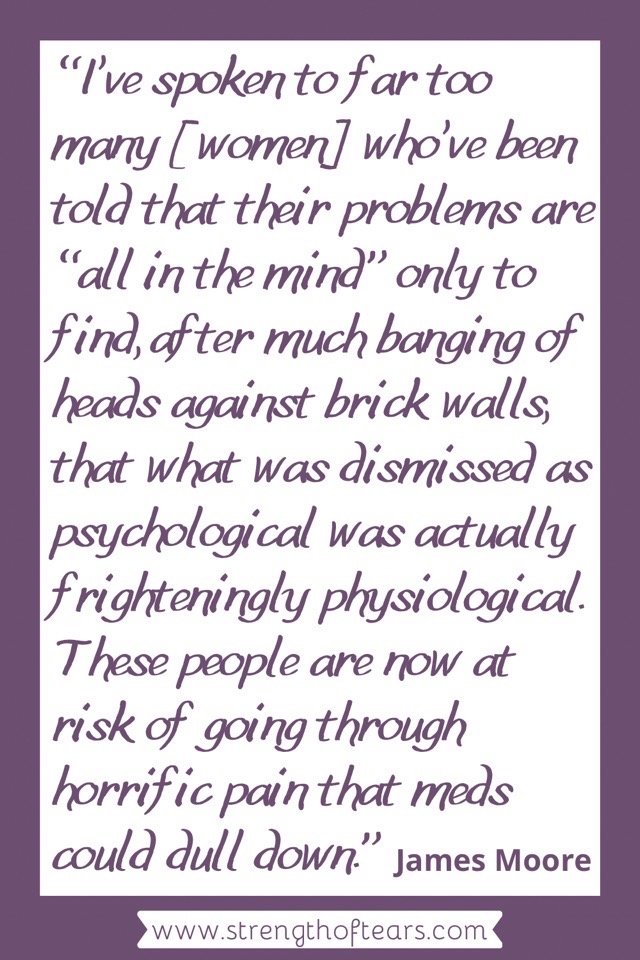
    “I’ve spoken to far too many [women] who’ve been told that their problems are “all in the mind” only to find, after much banging of heads against brick walls, that what was dismissed as psychological was actually frighteningly physiological. These people are now at risk of going through horrific pain that meds could dull down.

    — James Moore

    Writing in the Independent Moore comments on the NICE guidelines recommendations for managing chronic pain in the UK: CBT; ACT; antidepressants; Acupuncture and exercise programmes. He says “the idea that a run around the block will zap the torment of people in chronic pain is patently ridiculous.”

    Claire Swain is navigating and sharing her own experiences. She wants to be clear that it isn’t that the approved treatments are bad as they may work for some, but there’s vast numbers for whom they don’t work or only work in combination with pain relief medicine. In this post she says:

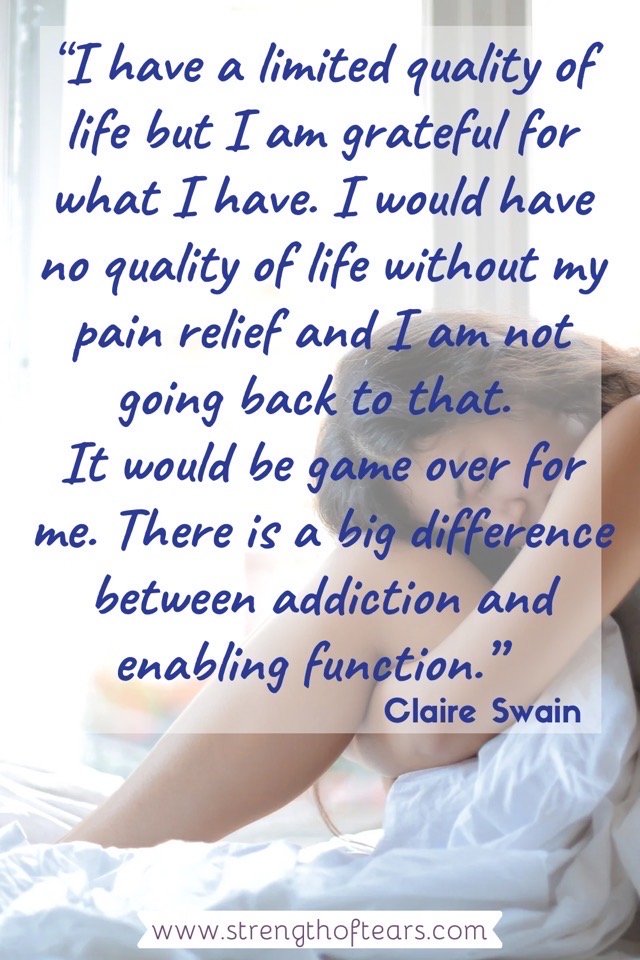
    “I have a limited quality of life but I am grateful for what I have. I would have no quality of life without my pain relief and I am not going back to that. It would be game over for me. There is a big difference between addiction and enabling function.” Claire Swain

    On one of my own posts to raise awareness of this campaign, Karen commented: “Taking these pain medications away has already led to suicides! We are not saying alternatives, such as acupuncture (although it didn’t for me) don’t work but in conjunction with pain relief, not instead of!!” Check out her profile here.

    When I think about what quality of life is for me, I think of being a Mum, wife, writer and friend despite spending most of my days in bed. What’s most important to me is connection, love, laughter and being there for my kids. I can do it all if I have the support I need.

    None of this would be possible for me without pain relief. Managing my pain means that I can be engaged in life. But if I didn’t have this pain relief I wouldn’t be able to move, not even lift my head off the pillow! How’s that for quality of life?

    I’ve experienced chronic pain since 2014, saying in this blog “After I’d blacked out… my pain levels were so high, I was shaking… My GP prescribed a cocktail of pain relief, including Oramorph… My chronic pain conditions [leave] me unable to do anything.

    The Takeaway…

    These testimonies show that patients with chronic pain in the UK are losing their quality of life because the NICE guidelines aren’t clear about the withdrawal of medication. Doctors are already treating the guidelines as a blanket approach and removing pain relief incorrectly.

    This statement from the Faculty Of Pain Medicine highlights that healthcare professionals must make these “decisions appropriate to the circumstances of the individual patient, in consultation with the patient and/or guardian or carer.”

    The recommended alternatives to pain medication won’t work for many patients with chronic pain in the UK but if used alongside pain relief they may enable better function. It’s vital that GPs know chronic pain is torture and for many of us, painkillers are vital for our sanity.

    All we really want from the chronic pain treatment UK is the ability to individualise how we manage our pain with the support of medical professionals. We should not need to prove our pain is real for this to happen. With support we have a quality of life, which is priceless.

    And Finally…

    I’d like to thank Claire and her team who have worked so hard on this campaign. She said “The campaign has a Team that I am beyond grateful for their support and hard work.”

    • Sasha Twinham

    • Ann Sinclair

    • Kelly Brownell

    • Terri Hester

    • Niki Boswell

    • Leanne Robson

    • Jackie Low

    • Georgia Siobhan

    • Julie Andromeda Mao

    Laura 💜

    #block-819524691f83f63e5f85 .sqs-gallery-block-grid .sqs-gallery-design-grid { margin-right: -20px; }
    #block-819524691f83f63e5f85 .sqs-gallery-block-grid .sqs-gallery-design-grid-slide .margin-wrapper { margin-right: 20px; margin-bottom: 20px; }

    ✋ Hey there! I hope you’re feeling stronger now. If so, sharing the love will help me help other mums with chronic invisible illnesses.⬆️  Hit one of those sharing buttons or save these images to Pinterest and I will do a bed-bound happy dance – there’s an image for you!

  • What To Accept After Years Of Intracranial Hypertension Treatment

    What To Accept After Years Of Intracranial Hypertension Treatment

    What I Need To Accept After Years Of Rare Intracranial Hypertension Treatment

    Rare Disease Day 2022 is always on the 28th February, so at this time of year I tend to reflect on the treatment I’ve had for the rare brain disease I have – Idiopathic Intracranial Hypertension (IIH). 

    I’ve been treated by a specialist team in Cambridge for the past 7 years. They’ve developed rare treatment plans for patients, who like me, often present with atypical IIH symptoms. Sadly, the treatment options they’ve developed have been exhausted in my case.

    I spoke to my neuroradiologist about this last month and he asked about the results following my first procedure, so I re-read my notes and the hopeful blog I’d written back then. I now have to accept that my symptoms haven’t resolved as I’d hoped and this blog could help.

    The surgical team has established unorthodox medical care that most neurologists consider controversial. This affected the support I received, so I had to learn to advocate for the care I wanted. Medical journals now publish more on these treatments, giving me hope. 

    In this blog I’m going to look at:

    • My Background Story Of Idiopathic Intracranial Hypertension 

    • What I Wrote About How I Felt After This Procedure 

    • The Results Of My Following Treatments 

    • What I Am Feeling After Completing My Treatment Plan

    My Background Story Of Idiopathic Intracranial Hypertension 

    In January 2014 I became ill and was diagnosed with chronic migraine, but after years of migraines I had doubts. I grew aware of a symptom I’d never experienced before, a whooshing in my ears. I researched Pulsatile Tinnitus (PT) and my family doctor confirmed it.

    I found an ENT surgeon who specialises in PT and he believed I had IIH. But my symptoms don’t fit typical diagnosis factors, so with the support of my wonderful family doctor, I had to advocate for 18 months to get their Intracranial Hypertension treatment. 

    IIH, it’s symptoms and my full story are detailed on this blog. My main symptom is constant head and facial pain that’s mostly right sided and mobility issues due to imbalance. I also have brain fog, nausea, photophobia (light sensitivity) and PT.

    In October 2014, my IIH diagnosis was confirmed with a lumbar puncture and a CT venogram (scan with dye). This showed narrowed veins at the skull base and venous sinus stenosis, where the large vein in the brain is narrowed. This causes fluid build up in the head. 

    IIH is a rare disease that affects 1-3 in 100,000 people. My scans identified Transverse Venous Stenosis causing constricted outflow in the veins at the back of my skull. This and the lack of papilledema puts me in the group of 6% of all IIH patients with this presentation. 

    Their Idiopathic Intracranial Hypertension treatment is controversial with most neurologists. IIH is usually accompanied by Papilledema, which if left untreated can lead to loss of vision. The pressure reading from a lumbar puncture is usually very high, mine wasn’t. 

    When I’d mention the Cambridge team or IIH, my local neurologists turned me away. I found one who would see me, but she still didn’t agree with the team’s radical surgical plan to remove some bone to improve venous outflow in my neck (see below for details).

    This sounds outrageous but my pain and standard of living was so debilitating that I’d try anything for relief. The plan was brain and spine surgeries and stenting the narrowed vein in my brain. This article explains the link between venous sinus stenosis, PT and IIH.

    Reflecting On The First Procedure Of My Treatment Plan

    After a very long year of waiting, the team’s neuroradiologist was able to perform my first Intracranial Hypertension treatment. I had a cerebral angiogram and venoplasty as an outpatient procedure to see if surgery to expand a narrowed vein would be beneficial. 

    They thread a catheter up to the blood vessels in the neck that supply the brain, imaging and measuring the pressure inside my veins. Then they inflate a balloon in the vein (venoplasty) to monitor how it responds to decompression over a week. 

    I noticed a difference immediately and by the time I went back to the ward I was a different person to the one admitted that morning. I had lower pain levels, no nausea and a clearer head. The difference was visible and as I chatted, Joel, my husband, said “you’re Laura again”. 

    The improvement continued over the following days. I was able to walk the stairs, which I hadn’t done for 12 months, I didn’t need any oramorph, which I’d been taking 2 or 3 times a day and I reduced my other pain killers temporarily.

    My PT and nausea returned first and a week later I woke up in my usual state of brain fog and pain. My surgeon was pleased with the results of the venoplasty. Although temporary they clearly showed I had restricted venous outflow and that surgery should be beneficial.

    What I Wrote About How I Felt After This Procedure 

    I’d been told not to be disheartened if the symptoms reappeared the following week but it was frustrating to return to debilitating pain. However, I was pleased that this proved I didn’t just have chronic migraine.

    At the time I wrote “I am… pretending I’m ok, feeling bad for moaning about hurting, crying and letting people down and not being able to do things with my family… [as] the pressure [builds again]. 

    [I’m] missing out on… living life… trying to explain why everything takes so long and feeling worthless… knowing that the freedom of mobility is drifting away. [I’m] crying and waiting for that time bomb of pain to build so much that [I] can’t take anymore.

    I have meditated, eaten, napped and had a few pep talks from friends and my husband… There have been tears today but I’ve been reminded that I [will] see my amazing boys grow up… with my best friend [Joel] of 18 years. 

    I have hope that there might be light at the end of this very, very long tunnel… I have amazing friends and family that are always there… even though I feel I’ve let [them] down by only being better for a few days… [when] I was so tired I just slept! 

    I am back making jewellery… reminding myself that I CAN still do things that matter despite feeling like I’ve been run over by a truck after drinking… whiskey.” My true friends have stuck by me and Joel still gives me pep talks. He and the boys keep me going each day.

    The Results Of My Following Treatments 

    It wouldn’t be a complete reflection if I didn’t share the Idiopathic Intracranial Hypertension Treatment I’ve had since that first procedure. This blog has been more emotional than I thought because it’s shown me how poorly I was at the start of this journey. 

    I’ve had venoplasty procedures and many CT venograms. These show how the jugular vein passes through a small space between two bony structures, the styloid process and lateral mass of the C1 cervical spine. In my case the jugular vein is narrowed and flattened. 

    The anatomy of these areas are shown in these images.  

    This is my IIH story outline of the surgeries I’ve had: 

    1. Styloidectomy – removal of a small bone fragment that sticks out of the skull, behind the ear.

    2. Stenting on the right side of the transverse venous sinus.

    3. C1 mass removal of the right transverse process.

    4. Re-stenting the right transverse sinus due to a compromised stent. 

    5. C1 mass removal of the left transverse process.

    6. Stenting on the right side of the transverse venous sinus. 

    With each surgery I’ve seen some improvement, most notably my cognitive ability. My final surgery, in 2019, has had the most impact. My balance improved significantly and a month on, I managed a day out with my family, using a wheelchair, for the first time since 2014.

    I’ve hoped for a life without constant pain since 2014. My symptoms improved with each surgery. Sadly I still suffer daily but there are positives from my treatment, mostly being able to be a good mum & wife.

    What I Am Feeling After Completing My Treatment Plan

    It’s been emotionally challenging reliving my IIH patient stories again. There’s been many tears as I think back to the hope I had for this treatment, a normal life off of the merry-go-round of constant pain. I’d naively counted on my surgeons to fix me, so the reality is crushing. 

    When the first venoplasty procedure had clear results, confirming I’d benefit from venous stenting surgery, I felt optimistic. Every surgery improved my condition but I’d gradually worsen each time. 

    Reading a blog from the start of this journey shows how challenging communication was for me. I’d be stuck there without surgery which would have broken my family. As I complete my treatment, the harsh facts are that I suffer daily but I am able to be a good mum and wife

    This 2012 US case study states that “Intracranial venous hypertension may result from… compression of the jugular veins at the skull base. Although rare… [it’s ] important to recognize [this] because stenting…may actually exacerbate the outflow obstruction.“

    My surgeon stated this could happen with stenting. He described it as removing a blockage at the top of a hose pipe, when it’s squashed lower down. The water builds up, leading to increased pressure. 

    My scans still show narrowed veins at the skull base but I’ve had all bone surgeries recognised for treating IIH. My surgeon can only see one possible surgery to relieve pressure here but it isn’t seen as a viable treatment for IIH. I’m frustrated by having to forget this option. 

    All involved are disappointed about completing this treatment plan without the success we’d hoped for. But PT took me down this path, and I’d hoped that this symptom would be resolved. As this is mostly the case, then I can count this part of the treatment a success. 

    This has reminded me how my quality of life has improved because of my Idiopathic Intracranial Hypertension treatment plan. The positive outcomes are:

    • The cognitive change I’ve experienced is quite dramatic. 

    • My mobility has improved so much I no longer fall.

    • I can walk on one level of the house, without mobility aids.

    • I don’t experience daily dizziness or vertigo 

    • My phonosensitivity is less invasive

    Sadly, my head pain remains constant, despite initial improvement after surgery. My high pain levels are disruptive so I still spend much time in bed. It still takes days for me to recover from any activity, even going downstairs, which can feel oppressive. However, over time I’ve learnt how to priortise for better life balance.

    I’ve created this free wellness planner to help you prioritise for better life balance too. This is also a taster of the the Thrive Not Just Survive Journal, for mums with invisible illnesses coming out soon. Simply click on this link to sign up for your free copy. Please feel free to ask me any questions you have about using this resource.

    It’s been an exhausting journey but looking back I take the positives, such as my ability to build connections, from my treatment as I move forwards. My surgeon has suggested a doctor sympathetic to their work, who I’m working with on the next stage of my treatment plan. 

    It’s scary saying goodbye to familiar territory as I complete treatment in Cambridge. I’m reassured and hopeful after speaking to my new doctor, but I’m anxious and apprehensive about what I face ahead.

    P.S. If you’re a skim reader, catch up here –

    I’ve been reflecting on my unusual IIH or Intracranial Hypertension treatment. This rare brain disease causes debilitating pain, mobility problems, brain fog and more. I re-read a hopeful blog I’d written in 2015 after my first procedure, when my husband said “you’re Laura again” as soon as he saw me. As this treatment ends I accept my symptoms haven’t all resolved but there are positives I can take on into the next part of my journey. 

    #block-yui_3_17_2_1_1647542983744_17509 .sqs-gallery-block-grid .sqs-gallery-design-grid { margin-right: -20px; }
    #block-yui_3_17_2_1_1647542983744_17509 .sqs-gallery-block-grid .sqs-gallery-design-grid-slide .margin-wrapper { margin-right: 20px; margin-bottom: 20px; }

    ✋ Hey there! I hope you’re feeling stronger now. If so, sharing the love will help me help other mums with chronic invisible illnesses.⬇  Hit one of those sharing buttons or save these images to Pinterest and I will do a bed-bound happy dance – there’s an image for you!