
Why You Need An Instructive Journaling Guide To Beat Toxic Negative Self Talk
Do you ever obsess over a mistake or unkind word? Do you feel shame for being vulnerable or dismiss negative emotions? These are self-talk examples from your inner critic or Judgy McJudge voice – the toxic voice in your head that can hold you back from success.
You’re either an optimistic or pessimistic person, and this determines whether your self-talk is positive or negative. It influences how you see yourself and the world around you. But ‘all or nothing’ thinking is how your inner voice becomes toxic, so you need to find balance.
I can help you identify your first step to change. Learn how to silence the devil on your shoulder by getting down and dirty with your inner critic. The journaling guide I’m writing will help you spot targets for your toxic negativity, use positive self-talk phrases and much more.
This blog explores negative and positive self-talk, negativity bias and how to balance your inner narrative. I share my experience of taking out my toxic thought cycle and discovering my inner guide. Finally I share strategies on how to develop balanced positive self-talk phrases.
Beat Toxic Negativity And Find Positive Self Talk Phrases
Negative self-talk can be suffocating and affect us and those around us. When I was first sick, I felt immense guilt which seeped toxicity into my family life. This guilt came from my inner critic which, to me, sounded like a critical parent, but this sounds different for everyone.
Positive self-talk can also become toxic, if you force positive thinking. Suppressing or dismissing negative emotions is an example of toxic positivity and is not what I’m recommending. We need to find balance and therefore, we know that we learn from making mistakes.
Self-talk is, however, more likely to become toxic negativity so I’m focusing on how to conquer this. It’s probably the most important act of self care you can do. Although it’s manageable, it will take time and patience so using a journaling guide helps you find your way.
Finding your positive inner voice or inner guidance can change how you approach life’s challenges. This isn’t ignoring negative thoughts, rather, reframing your viewpoint. To find the positive self-talk phrases you need, you first need to identify your self-talk styles.
Negative Self-talk can sound like:
-
Catastrophising – thinking of worst case scenarios all the time or taking what someone has said and going all in e.g. “She was right, I’m not a good mum, I’m always shouting.”
-
Personalising – where you blame yourself e.g. “I’m unfriendly” if someone communicates badly or ‘I’m a failure’ when you make one tiny error.
-
Polarising – where you only see the world in black and white, ignoring any positives in a situation e.g. “I messed up that new system at work today so my boss is annoyed with me.”
-
Magnifying – leading your mind into a fear-based fantasy e.g. “I’m never going to get that promotion.”
Your negative inner voice can be useful, warning you of the negative impact something may have. An instructive journaling guide shows us how this self-talk type can help us achieve a goal. It also ensures that you keep your self-talk balanced with positive self-talk phrases.
However, negative self-talk can have severe affects on your mental health such as increased anxiety, lower motivation, missed opportunities because you talk yourself out of doing something that would be a success. This blog from anxiety-gone.com explores this is more detail.
Positive Self-talk can sound like:
-
Minimising – reducing the impact of something someone has said or done to you, or of how you feel about something e.g, “It doesn’t matter what she said, I know I’m a good mum.”
-
Absolution – where you forgive yourself e.g. “It’s not my fault if they didn’t communicate what they wanted to me” or “It’s okay, I’ll try again’ if you make a mistake.
-
Connecting – where you see the grey areas in a situation, seeing both positives and negatives e.g. “I messed up that new system at work so we can all learn from my mistake.”
-
Self awareness – talking yourself down from a disaster e.g. “I might embarrass myself, but the interview is experience.” Or it makes you think twice e.g. “I shouldn’t feel like this.”
The journaling guide I’m creating is focused on exploring negative and positive emotions which are interlinked with your inner voice. To find your inner guide; try different approaches to see what works for you, identify patterns and switch it up with positive self-talk phrases.
“When you start paying attention to the type of self-talk you are using, you can take the steps to overcome the effects.
With awareness of the self-talking pattern, you can modify your thinking, improve your mental health, and reduce negative feelings.”
Heather Rashal
The Negativity Bias And Its Impact On Your Wellbeing
Before self-talk can become your guide, you must be aware of how negative bias affects your inner voice. Subconsciously you’ll lean toward negative thoughts, actions and beliefs from infancy, due to a primal need to focus on the danger all around us, for survival.
Negative bias pushes the pain of disapproval more strongly than the comfort of appreciation. The absence of positive self-talk phrases influences your behaviour, decisions and relationships negatively.
“Our brains are hardwired to remember negative experiences over positive ones, so we recall the times we didn’t quite get it right more than the times we do. We then replay these messages in our minds, fuelling negative feelings.” Gregory L. Jantz – 2016
For example, we will:
-
Retain memories and sensory links to past traumas.
-
Hold on to blame, even if we were praised for the same event
-
Think about negative things more often than positive ones
-
Learn more from negative events and reactions.
Negative self-talk affects your mental wellbeing, often damaging your confidence, increasing stress levels, triggering feelings of shame or self-blame and crushing your self-love. It can also lead to or worsen mental health issues, such as anxiety, depression and PTSD.
In my case, I had a life-long tendency towards guilt and self-blame, but this worsened considerably when I got sick. My breakthrough was working with my life coach, who used journaling guided exercises to help me gain awareness of my self-blame and guilt.
The work revolved around making my thought process adaptable. I imagined a creature saying these negative phrases and named it the Guilt Goblin. Doing this helped me push the negative away and use positive self-talk phrases to tip the scales for more balance.
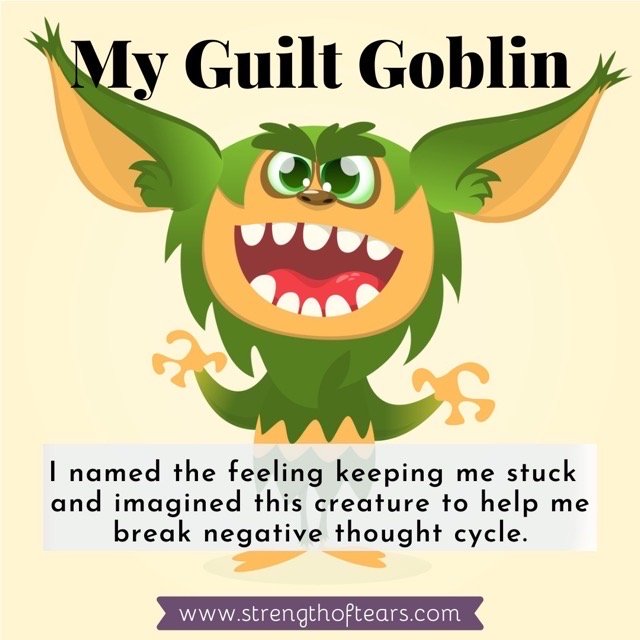
My Guilt Goblin
I nicknamed this imaginary figure to tell my brain that I don’t have to agree.
It shows me that my critical thoughts are ridiculous.
Using this nickname for the feelings of guilt and self-blame in my negative thought cycle have helped me break from away from this toxic negative self-talk.
Your brain craves stimulation to challenge negative self-talk. Having a journaling guide helps acknowledge these negative thoughts so you can challenge them and create a more positive outlook, which results in inner guidance that builds your self worth.
An effective journaling guide creates space to reflect on your negative experiences, so you can find patterns and learn from them, halting negative toxicity. This allows you to change how you talk to yourself, which has a roll-on effect in how you behave with others.
I’m often asked how I keep positive, living with unrelenting pain. I use positive self-talk phrases or affirmations, to provide inner guidance to help me focus on the journey, not the destination. I learn from the negatives and preserve positive experiences, letting go of the rest.
How Targeted Journaling Can Really Boost Your Positive Self Talk Phrases
Establishing practices to create balance has driven my creation of the targeted journaling guide. Focusing on positive and negative thoughts allows you to tune into your inner guide and believe you can achieve. Initiating positive self-talk phrases promotes an optimistic outlook.
Studies have shown that optimistic thinkers are more successful, do better academically and recover more quickly from surgery. You can develop a positive mindset using a targeted journaling guide that focuses on self-belief and meeting your goals.
Negative bias means you’ll listen more to the devil than the Angel on your shoulder. This allows self-doubt, shame, guilt and misguided worry to tip the scales the wrong way for your mental health. But you can stop toxic negative self-talk dominating your mind if you work at it.
I don’t mean ignoring life’s challenges, rather finding productive ways to cope with stress. By redistributing positive self-talk phrases you can develop a constructive inner dialogue. Balancing your mind and the world around you, enables you to develop a steadier inner guide.
Here’s how to start your journey to reframe your thoughts:
-
Your internal narrative is constant so you need to develop self awareness of your thoughts. Pause to tune in to your brain’s frequency, remembering that not every thought you have is true.
-
Learn to recognise negative self-talk or when you dwell on an issue. Don’t try to stop your thoughts, this has the opposite effect, but try to think of solutions. You won’t always need to act but going over the steps you’d take helps you to move on.
-
Recognise your own negative bias by considering both sides of an argument, then ask if your thoughts are accurate. Make time to reflect on the patterns to show you the opposite is true when your thoughts become overly negative.
-
Switch gears – when a negative thought enters your mind, stop and think how to flip the phrase using positive language. For example, ‘this is too much change’ to ‘I’ll tackle this one bit at a time’ or ‘I can’t do this’ to ‘I’ll learn the next step.’
-
Use positive self-talk phrases or affirmations regularly. Such as “I am capable and strong, I can do this’ or ‘I am proud of myself for having the courage to try”. Say these out loud for full effect and have visual cues, such as in a journaling guide.
-
Consider the advice you’d give a friend in a negative frame of mind. You wouldn’t tell them they’re stupid or a loser, so why say this to yourself? Offer yourself the same kindness and encouragement you’d show a loved one.
-
Check-in with your emotions regularly, identifying different feelings can be tricky as there are blurred lines. My journaling guide has a system for looking at opposite emotions so you can balance them.
-
Try “thought-stopping”, where you use an action to change to another thought if you have extremely critical thoughts. Try pinging a rubber band on your wrist, read aloud positive self-talk phrases or affirmation cards or visualise a stop sign.
The following methods are for longer term changes. This is where the Journey To Balance Journal, your targeted journaling guide, will help you plan long term strategies for finding a balanced inner guide.
-
Identify your negative self-talk traps, such as feeling anxious in large social events. Knowing which areas of your life you lean more negatively to, allows you to make a focused plan of when and how to approach each area more positively.
-
Create boundaries by reducing or removing contact with people who encourage negative talk. Strong boundaries are essential in life so teach your inner voice how to say no by collecting phrases that help you stick to your own lane.
-
Go with your worst case scenario so you can see that the catastrophe you’re predicting is very unlikely. Remind yourself of real situations where things haven’t gone well, so you know that you can handle difficult outcomes,
-
Work on accepting your flaws and plan how to address the things you want to change at the same time. Remember that the process of using this targeted journaling guide is to help you find balance in life and your inner voice.
-
Plan uplifting activities to break the cycle of negative self-talk. Examples of this – breathing exercises, dancing, singing, going for a walk or talking to a friend about something else.
-
Show gratitude for positive moments, big or small, using your journaling guide to record them. Your brain needs more positive experiences to make them count so record and make time to re-read your journal often to reinforce this.
Look out for my new journaling guide, coming soon. The core focus is on balancing your emotions but with my top positive self-talk phrases, it’s perfect to kickstart finding your inner voice balance.
If You’re Still Wondering…
What is self-talk and why does it matter?
Self-talk is the voice in your head and can be positive or negative. Your inner voice is personal but most of us have experienced getting stuck on a thought about your own or another’s actions or comments. It can become all-consuming, leading to toxic negativity.
If you let this voice become heavier on one side it takes much more work to reframe it. Positive self-talk is thought to lead to self-esteem, healthier relationships and problem-solving skills. It has even been linked to lower stress levels and better general wellbeing.
“The mind is like Velcro for negative thoughts and Teflon for positive ones”
Negative bias is where negative interactions stick over positive ones of equal weight. This leaves negative self-talk as the more prominent voice and it can easily become toxic. If you put in the work to reframe your inner narrative you can develop a strong inner guidance.
Dull the devil on your shoulder and develop the strategies you need with your journaling guide. The Journey To Balance Journal engages your inner narrative so you can find your inner guide at your own pace,
Whether you’re fresh faced and fancy free, a contrary, crumbling crank or a ready and raring rebel, pause for a moment. Take every opportunity to check your self-talk and give yourself some love today!
And Finally…
If you are suffering from a toxic negative-self talk cycle you may need more than my advice. I am a trained mentor and because of my own experience, I can guide you from personal experience, in confidence. However I am not a trained, mental health professional.
If you feel unsafe due to persistent and invasive, negative thoughts, or are having difficulty looking after yourself, please seek a medical professional’s opinion:
-
Talk to your doctor about the first steps to help when negative self-talk takes over. They can connect you with the right help.
-
Therapists can help you explore how and why you’ve learnt negative ways of thinking, usually from parents or caregivers. They can provide effective and customised ways to improve your relationship with yourself and others.
-
Cognitive behavior therapy (CBT) or acceptance or commitment therapy (ACT) will teach you the skills you need to manage false logic or overestimated threat.
-
If you feel that you need support because you’re worrying more than usual, having thoughts and feelings that are difficult to deal with or aren’t enjoying life and need support, I recommend this guide from mind.org.uk.


#block-yui_3_17_2_1_1651422700122_25194 .sqs-gallery-block-grid .sqs-gallery-design-grid { margin-right: -20px; }
#block-yui_3_17_2_1_1651422700122_25194 .sqs-gallery-block-grid .sqs-gallery-design-grid-slide .margin-wrapper { margin-right: 20px; margin-bottom: 20px; }
✋ Hey there! I hope you’re feeling stronger now. If so, sharing the love will help me help other mums with chronic invisible illnesses.⬆️ Hit one of those sharing buttons or save these images to Pinterest and I will do a bed-bound happy dance – there’s an image for you!






 Strength Of Tears