Tag: IIH Awareness Month

  • The Cruel Impact Of Being In Agony With Brain Fog & IIH Headaches

    The Cruel Impact Of Being In Agony With Brain Fog & IIH Headaches

    The Cruel Impact Of Being In Agony With Brain Fog And IIH Headache

    An Asian woman with long black hair is wearing a green blouse and has her head in her hands in pain. The writing on the left says 'the cruel impact of being in agony with brain fog and IIH headaches

    This IIH Awareness Month, I want to share how brain fog affects me as someone with IIH headache. IIH or Idiopathic Intracranial Hypertension is a rare brain disease affecting 1-3 in 100,000 people. I’ve had IIH for over 8 years and it has improved a bit with treatment.

    IIH., which you can read about here, has no known cause (idiopathic) and is focused in the brain (intracranial) where it raises pressure (hypertension). Headache is my most severe symptom, my second is brain fog, a type of cognitive dysfunction.

    The name gives it away, but it’s literally a foggy brain state! Brain fog and headaches are both constant for me. Never getting a break from these symptoms is exhausting. Initially my memory was so poor, to have a conversation was a challenge for me, as a mum, and my family. It’s less extreme now but still affects me daily.  

    Here I’m going to tell you about the symptoms of a foggy brain and  how long it can last. I’m also going to explain how this affects me, as someone with IIH headache and migraines. Then I’ll share tips for better managing brain fog and headaches as a tired mum.

    What Are The Symptoms Of Brain Fog? 

    Brain fog is not a medical term, but a term for those who experience a groggy mind. Read more about brain fog causes here. The most common symptoms of brain fog are short term memory loss, mental fatigue, unclear thoughts, trouble finding words and a sense of non-reality.

    For those with chronic illnesses, such as my brain fog and headache conditions of IIH and migraine, foggy brain also often occurs as an inability to follow simple instructions, extreme tiredness, difficulty processing information, being easily distracted and confused. 

    My symptoms of brain fog show up as all the above but I also have difficulty following a conversation, I struggle to find the words I need and multitasking is hard work! I feel as though I’m wading through treacle, everything slowing down and information is stuck hard. 

    Others will encounter their symptoms differently, as it can change from day to day and even fluctuate over the same day. My husband, Joel, is often dragged into twilight discussion as I try to share a story from the day. I often lose my place, go off track and then go back a step or restart, finding I’ve forgotten the point of the story anyway! 

    How Long Does Brain Fog Last? 

    There isn’t one answer for this, usually symptoms of brain fog are temporary or happen in short bouts over more time; it’s different for everybody. Those with brain fog and headache conditions often have persistent mental fog, which is felt on a sliding scale of severity. 

    The Coronavirus pandemic shone a spotlight on brain fog and research has shown that those with long Covid will have the symptoms of brain fog for weeks or up to many months. They did find that brain fog decreased in severity over time. 

    Prior research into mental fog was sparse, but with new scientific studies we’re learning more about brain fog and so improvements for symptom management are more likely. It’s vital to reassure anyone with constant brain fog, that they will not have lasting brain damage.
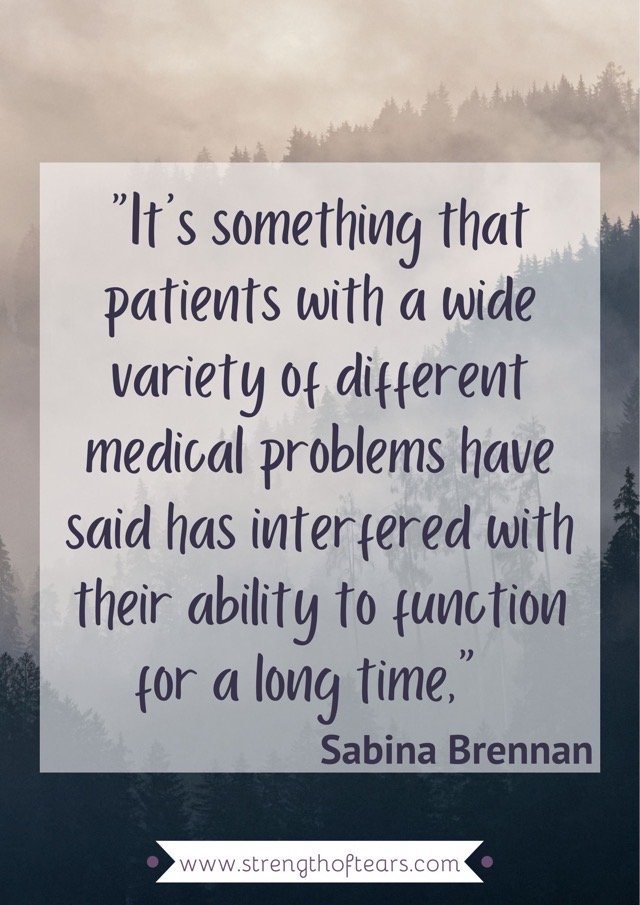
    Mental Fog

    Brain fog is like walking through a dense forest that doesn’t seem real. This analogy of brain fog shows how much it can impact your ability to function when a foggy bran is persistent.

    How Brain Fog and IIH Headaches Impacts My Life

    I believe it’s crucial to raise awareness of IIH symptoms, so I released this blog last year. became very unwell, overwhelmingly with brain fog and headaches, and had to leave my 15 year career as a teacher. These symptoms of brain fog dominate my life with IIH.

    I am one of less than 6% of patients with IIH who have IIH without Papilloedema. This is swelling of the optic nerve that can lead to blindness if untreated. IIH symptoms are debilitating and impact quality of life, especially as the most common symptom for us in the 6% is headaches.

    The cruel IIH headache I have on both sides of my head and around, below and behind my right eye, is like permanent brain freeze, migraines and facial neuralgia all at once. However, I also have constant, debilitating mental fog which affects every aspect of life.

     Brain fog surrounds all of my IIH symptoms:

    • Before the pain heightens, I feel agitated and confused 

    • When it eases I’m dopey and slow to process information 

    • High pain means poor sleep which leaves me even more tired

    • The medication I take makes me sluggish and confused

    • Living in the dark due to light sensitivity affects my sense of time

    • Hyperacusis (magnified sound) and vertigo makes the world not seem real

    When brain fog and headaches work together, my IIH symptoms are incapacitating. When I was first ill these symptoms were so severe I lived in an almost fugue state, impacting all my relationships, even my marriage, as I just couldn’t maintain a conversation.

    “Pain like this, felt at the core of one’s being, in the brain, carries an added challenge in interfering with how you think,” Paula Kamen 

    I’ve had 6 surgeries in the last 7 years, including having brain stents implanted on both sides of my brain. My brain fog improved a little with each surgery as the intracranial pressure reduced a little. It still affects me daily but now I’m able to write coherently.

    I’ll always have impaired brain function but now I can see the funny side when the pain eases a little. Brain fog can lead to humorous but frustrating events, such as when I put hand cream on my face or wear a top inside out all day. You just have to laugh!
    A woman with Down's Syndrome is wearing black leggings and sleeveless top with white trainers. She sits in steps in front of a wooden door as the wind blows her hair. The writing says 'How Tired Mums Can Better Manage Brain Fog And Headache

    How Tired Mums Manage Brain Fog

    Tiredness can slow your thought process but a mental fog affects the brain’s ability to think clearly. Brain fog is more than tiredness and makes life more even more challenging.

    How Tired Mums Can Better Manage Brain Fog And Headaches

    All mums experience exhaustion but no amount of sleep will ease a foggy brain migraine or IIH headache.  When we have IIH symptoms, life can be extremely limiting and tiresome but any headache condition exposes us to fatigue. This adds to mental fog and makes life even harder to manage.

    As someone with IIH headache and a chronic migraine sufferer, I have daily brain fog. I’ve particularly noticed my inability to remember details, have conversations, manage my time and multitask; so I’ve collated this list of tips to better manage brain fog and headaches:

    • Sleep Routine – this is often the first thing to go as Mums but with brain fog too we need good quality sleep. I’m not suggesting 8 hours a night, as we’re all different but sleep hygiene is crucial for us all. Keep track of your sleep and what helps you sleep better. 

    • Eat Healthily – nutrition deficiencies can worsen brain fog so we need a balanced diet. My mental fog has improved a little now I’m vegan and more aware of nutrients. Supplements can also help, read more about that here.

    • Exercise – gentle exercise, like a short walk, can help. I don’t mean going to the gym or for a run. Physio got me more mobile and it’s helped my symptoms of brain fog. Now that I swim often, I’ve noticed even more improvements. Walking round the house and doing the washing counts as exercise! 

    • Keep Hydrated – Regular fluid is important for brain health, but alcohol and caffeine is dehydrating. I drink 3-4 litres to combat dry mouth side effects of my medication, but your body is unique. Try to drink about 2 litres of water a day. 

    • Relax – listening to my body means I tune in to when I need to rest, usually meditating or doing gentle yoga. To manage your stress you need to do positive self-care acts for yourself. This could be a long bath or catching up with friends.

    • Take a Break – regular short breaks from activity, helps us manage better. I use the Pomodoro technique when working,  25 mins focus, then a 5-10 minute break to do my physio or meditate, anything mindful is rejuvenating.

    • Get Organised – This is tough but essential for all mums! I struggle to plan a day, now I have IIH symptoms. I start with the simple act of getting up, following the same simple routine. Having a clear plan and structure gives focus.

    • Time Checks – pain results in our dopamine levels dropping to make us stop and rest but this also affects our memory. So use your phone for alarm reminders and memory prompts.

    • Focus – prioritise tasks so you can focus on one thing at a time and remove distractions. I have real difficulty multitasking, made worse by tiredness. Avoid doing things when tired or anxious so you can focus more.

    • Make Connections – It can be easy to feel isolated when we are struggling with mental fog. Connecting with those who understand what you’re going through can be incredibly helpful, whether it’s online or in person it gives you support

    I’ve created this free wellness planner to help you prioritise for better life balance, which will help you organise your way through brain fog and plan for dealing with the symptoms of brain gog ad headaches. Simply click on this link to sign up for your free copy. Please feel free to ask me any questions you have.

    If you’re struggling to cope with brain fog, it’s important to speak to your doctor or seek professional help from a therapist, counsellor or life coach. They can help you manage your symptoms, emotions and focus on finding solutions.

    In conclusion…

    The symptoms of brain fog affect people differently, depending on the cause and symptoms you experience, so what helps can be different for each person. As women and Mums, we may also be affected by hormonal changes which is important to be aware of. 

    For me, brain fog and headaches, especially my IIH headache, has impacted my brain function from the day my symptoms started. It affected my ability to have conversation, and even now after six surgeries, I often still don’t join the dots when processing information. 

    There are lots of things you can try to help ease symptoms. To find the combination that works for you, track your symptoms and what you use to work out what helps you. Many treatments involve lifestyle changes and day-to-day management of the symptom.  This IIH awareness month, see how I experience IIH by checking out my blogs. You can see how another mum found managing IIH symptoms in this wonderful guest blog.


    ✋ Hey there! I hope you’re feeling stronger now. If so, sharing the love will help me help other mums with chronic invisible illnesses.⬇  Hit one of those sharing buttons or save these images to Pinterest and I will do a bed-bound happy dance – there’s an image for you!

    #block-yui_3_17_2_1_1663686217746_56882 .sqs-gallery-block-grid .sqs-gallery-design-grid { margin-right: -20px; }
    #block-yui_3_17_2_1_1663686217746_56882 .sqs-gallery-block-grid .sqs-gallery-design-grid-slide .margin-wrapper { margin-right: 20px; margin-bottom: 20px; }

  • A Lonely Challenge: IIH Headache And A Baby

    A Lonely Challenge: IIH Headache And A Baby

    A Lonely Challenge: IIH Headache And A Baby

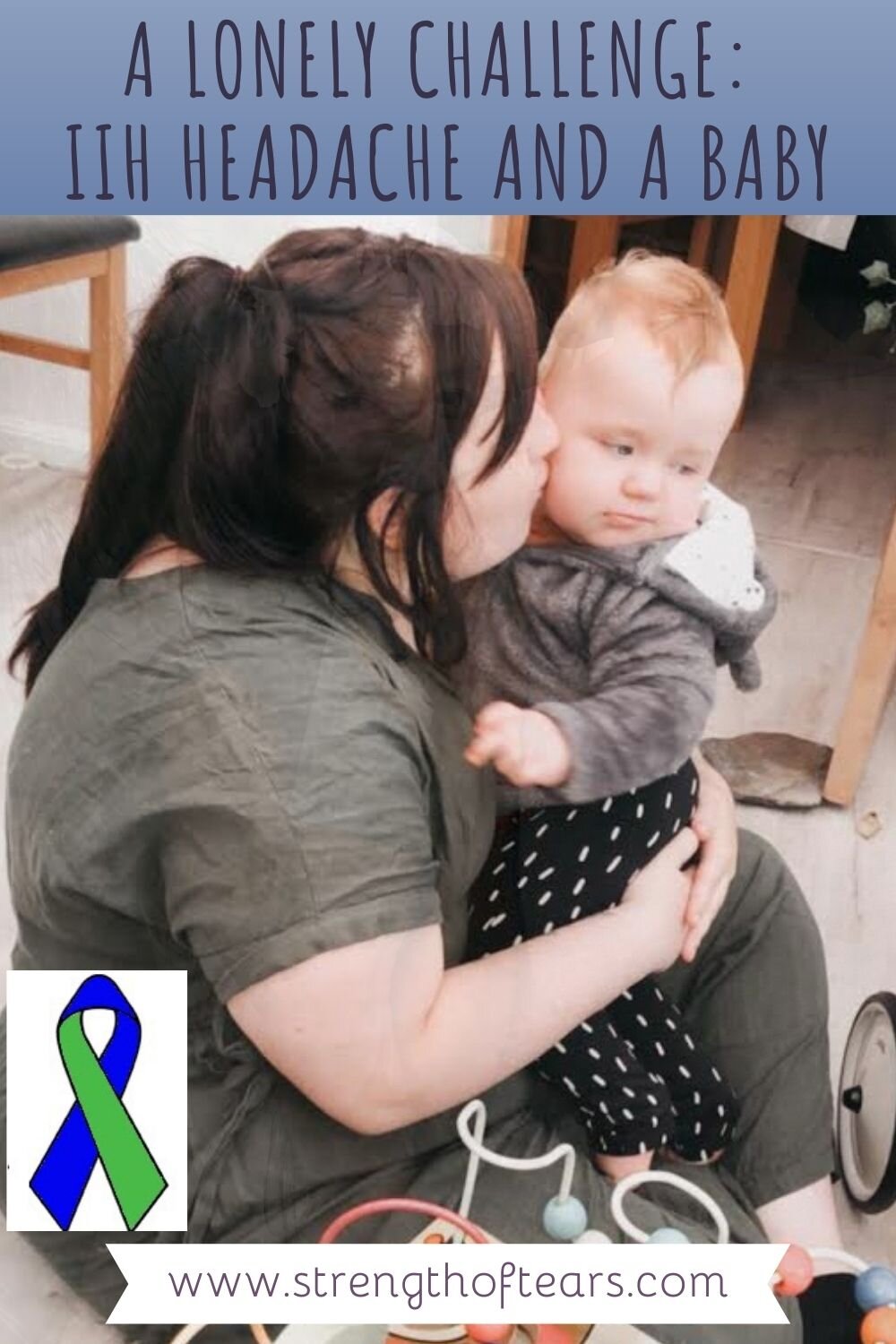
    A Lonely Challenge: IIH Headache And A BabyFor IIH Awareness Month, Amy has written this amazing guest blog about her experience as a 24 year old, newly single mum of a one year baby boy, recently diagnosed with Idiopathic Intracranial Hypertension …

    An Introduction To Amy’s Guest Blog

    For IIH Awareness Month, I want to raise awareness about Idiopathic Intracranial Hypertension or IIH through blogs with a range of patient voices. I’ve asked mums from the IIH UK Facebook support group to raise money for IIH UK, a charity supporting IIH patients and raising awareness.

    Please use the button below if you would like to donate to IIH UK through their Justgiving page.

    Amy has written an amazing guest blog about her experience as a 24 year old mum of a one year baby boy. She’s just moved back to Scotland to be closer to her family after being diagnosed with IIH fairly recently. 

    If you would like to understand  the symptoms, diagnosis and treatment of IIH from the perspective of other patients for IIH awareness month, read this blog post.

    She experiences crippling pain, with each severe Idiopathic Intracranial Hypertension headache which led to her diagnosis. However IIH is so much more than just a headache so here is Amy’s story, in this open letter to IIH.

    A Lonely Challenge IIH headache and a baby.jpg

    An Open Letter For IIH Awareness Month

    To my IIH for finally teaching me how to let go. 

    You can’t hold on to anything when you’re awake every morning with an excruciating headache that can only be described as brain freeze mixed with a car crash.  

    With every day, the hypertension headaches grew stronger and longer. I wasn’t present in my life for weeks, I was zoned out on autopilot trying to protect myself from the pain. Nothing worked. I tried everything from pain killers to mindfulness to not eating this and that.

    Then came the whooshing (pulsatile tinnitus ) and blurry vision that fearfully shook me back into the present.  I wasn’t just in pain anymore. I was scared. Really really scared. I knew something was very wrong! I googled my symptoms in every free second I could and my results told me I was either  “faking it” or I had a brain tumour.

    When my phone rang, (sort of like the way my ears did when I got my first headache), my GP told me I had ‘Idiopathic Intracranial Hypertension’. Luckily I’d done my research, so at that point I knew what she knew. Find out what IIH is by reading this IIH UK leaflet.

    However I didn’t know that my boyfriend would end our relationship and move out of our family home leaving me alone with our 8 month old baby son and the lonely challenge of my new diagnosis and that Idiopathic Intracranial Hypertension headache. 

    No one knew I’d need a lumbar puncture in a hospital which had had many covid-19 related deaths or that the procedure would make me so ill I’d had to be driven 300 miles, to be admitted to hospital in Scotland near my family home. 

    The lumbar puncture hurt almost as much as when my partner left me, the pain was deep and repetitive. Read about lumbar punctures here. https://www.nhs.uk/conditions/lumbar-puncture/ It made me question what was wrong with me and why, like always, things could never be easy? 

    I screamed and howled that night as my high pressure hypertension headache was traded with a low pressure headache. My sister held my hair while I vomited almost in unison to my sons midnight cries. How I wished being a mother was the least of my problems.

    They Thought I’d Be Okay.

    They thought I’d be okay but if it had been possible, I’d have easily spent the rest of my life in bed hiding from the world, silently taking note of every little change in me. With every bout of nausea the panic set in and I often found myself reliving the pain of the Idiopathic Intracranial Hypertension headache I felt when I was first diagnosed. 

    They thought I’d be okay but with every visual disturbance I winced at the thought of losing my ability to care for my son, drive or even completely losing my sight. It’s very easy to see why depression is a symptom of IIH. I consider myself extremely lucky that I do have good days as I remember a time, not so long ago, when I didn’t.

    By the time I had to quit my job, I’d started to regain strength. I felt proud that I’d managed to keep myself and my son alive and that we had a wonderful week in Scotland. Looking back it was a parallel universe to what I’d been used to. 

    The days were bright, the family home was busy and the sound of my thoughts no longer rattled off of every surface. I became determined to prove to myself and everyone else that I could fight one of the hardest fights I’d ever faced. 

    I lost 10kg in weight in less than a month. Everyone congratulated me and acted as if, by magic, all my problems would be solved and I’d be okay. Stereotypicaly women are somehow (wrongly) convinced that the more weight they lose the more successful they’ll be. 

    Unfortunately when you’re overweight with an IIH diagnosis, you are even more convinced that losing weight will be a miracle cure. Read more about views on IIH and weight loss here.

    Everyone thought I’d be okay but bed time was the hardest. I recoiled at the sound of my son’s screeches which threatened an Idiopathic Intracranial Hypertension headache. Thankfully we gradually found a routine along with our ability to self soothe. 

    Here I was, a 23 year old newly single, unemployed mum with an 8 month old baby and 3 chronic health conditions; living three hundred miles away from my family and friends. So I’m grateful to the friends who were always a phone call away, even though no one truly knew what I was up against. 

    A New Perspective - My IIH Headache Taught Me To Be Strong 1.jpg

    A New Perspective – My IIH Headache Taught Me To Be Strong

    My Idiopathic Intracranial Hypertension headache and friends taught me to be strong. Not relying on the strength of others is the greatest gift I could have given myself. Fighting everyday just to survive is so, so tiring but I started to reap the rewards and found a new perspective. 

    Whilst becoming a single mother is the last thing anyone would wish upon themselves, over time, it has given me back the independence and self belief I’d lost during pregnancy. 

    Nothing is more rewarding than the bond I have with my son. We are inseparable. Things are different now that my son and I get out of the house whenever we can. I do this because I want to, not because I’d feel like a bad mother if I didn’t. However, I think I’ll always live with guilt and what if’s.

    I’ve realised that I am the best mother for my son and that as long as I don’t stop fighting, however much I want to, little else matters. Doing the dishes doesn’t matter, how I look when I step out the door doesn’t matter and thinking “I’ll be happy when…” doesn’t matter.

    Now I try to create as many meaningful memories as possible for us. Sometimes this will be as simple as going to the supermarket and engaging with as many people as possible. Sometimes it will be playing together and having cuddles on the sofa. 

    IIH has taken so much from me that I’m not sure I’ll get back. I’m troubled by confusion and concentration issues from brain fog and that pervasive Idiopathic Intracranial Hypertension headache. My love of knitting, baking, reading, colouring and watching TV & film is all just not possible for me right now. 

    Instead I found comfort in self care, something I did prior to my diagnosis but from my new perspective, I truly appreciate it. I love painting my nails, using face masks and taking long baths. 

    A New Perspective - My IIH Headache Taught Me To Be Strong “My IIH headache and friends taught me to be strong. Not relying on the strength of others is the greatest gift I could have given myself. Fighting everyday just to survive is so, so tiring …

    How I Feel Now It’s September

    We’ve just celebrated my son’s 1st birthday. It’s been six months since being diagnosed and it’s IIH awareness month. I don’t know how I feel about any of these things and that’s okay. 

    Still so many thoughts turn in my mind. How is my baby 1 year old already? Why have I spent half of his life fighting, almost literally, to keep my head above water? What’s the next challenge, now that my baby and I are here? 

    I do know that for every second I’ve fought, a second of my son’s love is earned. I do know that there are mums out there just like me, laying awake at night exhausted. I do know that we’ll both be praying tomorrow will be different, even though it rarely is.

    A part of me wants to roll up IIH awareness month into a very small ball and chuck it tremendously far away. A part of me wants to leave this challenge behind me and my son and not have to fight this anymore.

    However, I know that we should be taking this fight to the hills. We should be taking it to the roof tops and everywhere IIH has taken us. We must tell everyone we can about the fight we face every day, with IIH headache, the pressure, the pain and the vision problems we all face. 

    As diagnoses are rapidly increasing, we need everyone to know how living with this brain condition affects us. We need to raise awareness of how we’re up against losing our sight and how poor the quality of our lives is. 

    Sometimes it feels like the specialists don’t believe us when we describe how painful the pressure of an Idiopathic Intracranial Hypertension headache is. When doctors don’t understand how frightening this condition is, it can be frustrating. IIH is not immediately life threatening but it does threaten our way of life.

    Amy 💚💙


    A Final Note From Laura

    Thank you so much to Amy for sharing her story for me to share. If you’d like to read more of what Amy has to say, she’d love you to follow her on Instagram @amylrobbo

    I’d like to finish this insightful blog post by sharing some information about how to support IIH UK. If you’d like to read my personal story about IIH please click here. https://www.strengthoftears.com/mums-blog/my-chronic-pain-conditions

    IIH UK wishes “to preserve and protect the physical and mental health of sufferers” as well as carry out research and  educate both the public and “the medical community in particular on the subject of IIH.” To enable IIH UK to do this please follow the instructions below. 

    To help us raise awareness please share this blog on your social media with friends and use #IIHAwarenessMonth. We’d love to be able to raise money for IIH UK so..

    •  If you share this on Facebook please add the donate button and choose IIH UK

    • If you share this on Twitter or elsewhere please use this link to the justgiving page, asking your followers to donate https://www.justgiving.com/iihuk/donate/ 

    Or donate now by clicking the link below and making your one off donation!

    Stay safe,

    L 💜

    P.S

    If you have IIH or any other chronic illness or you’re suffering from depression or anxiety, I can help you create better wellbeing strategies using my free wellbeing plan. This will help prioritise your own needs, such as better sleep patterns, self care or doing the things you love. Or if you want to get on a waiting list for updates on my first ever well-being journal, please sign up to my Strong Mums mailing list here.

    #block-yui_3_17_2_1_1600425276730_92643 .sqs-gallery-block-grid .sqs-gallery-design-grid { margin-right: -20px; }
    #block-yui_3_17_2_1_1600425276730_92643 .sqs-gallery-block-grid .sqs-gallery-design-grid-slide .margin-wrapper { margin-right: 20px; margin-bottom: 20px; }

    ✋ Hey there! I hope you’re feeling stronger now. If so, sharing the love will help me help other mums with mental health and/or chronic invisible illnesses.⬇  Hit one of those sharing buttons or save the images to Pinterest and I will do a bed-bound happy dance – there’s an image for you!

  • 6 Amazing Mums Helpful Secrets For IIH Awareness Month

    6 Amazing Mums Helpful Secrets For IIH Awareness Month

    6 Amazing Mums Helpful Secrets For IIH Awareness Month

    When I was diagnosed with Idiopathic Intracranial Hypertension (IIH) in 2014, I worried about the impact on my boys’ lives. They were 10 and 11 and it was hard on them. I was lucky as my husband stood by me as we adapted our parenting.

    But every parent with this condition has a different experience, for September’s IIH Awareness Month, I asked 6 amazing mums from the IIH UK Facebook support group, about their secrets as a mum with Idiopathic Intracranial Hypertension to help other mums in a similar position. 

    We’ve done this in the hope that we can fundraise for IIH UK so we’re sharing how IIH affects us as and our children to raise awareness of this rare brain disease. We’d be very grateful if you could make a donation to IIH UK to fund research.

    This invisible illness affects our role as a parent but many of us push through the pain, hiding how we feel from friends and family. One mum I spoke to said that when she’s in so much pain she cries, she hides to avoid  her children seeing her like that. We’ve spoken up this IIH Awareness Month with the hope of sharing the secrets of being a mum with IIH life.

    What Is IIH And Who Gets It?

    IIH occurs when levels of cerebrospinal fluid (CSF), which plays an important role in cushioning the brain, gets too much and the skull can’t expand so the pressure increases. The meaning of the term Idiopathic Intracranial Hypertension is:

    • Idiopathic – unknown cause

    • Intracranial – in the skull

    • Hypertension – high pressure

    This condition is found more commonly in women but does affect about 10% of men. It’s common in teens and young women, but can affect children and adults of any age. IIH occurs in 1-3 people in every 100,000. This is higher in those who are obese.

    The ladies I’ve asked, Sophie, Keri, Leah, Alexandra and Claire and myself range from 21 up to two of us, including myself, being in our forties. Two ladies have been diagnosed in the last year, with many feeling we had symptoms before our diagnosis. 

    During IIH Awareness Month, I believe it’s important to use this platform as a voice for these mums to share their experiences and thoughts about parenting with IIH. By sharing what we live with each day we can show our similarities and differences.  

    How Is IIH Diagnosed And What Are The Symptoms?

    IIH Awareness Month is about raising awareness of this condition. To be diagnosed with IIH someone needs to have brain scans and a lumbar puncture (LP), also called a spinal tap. These 5 things to rule out other conditions and confirm IIH:

    1. Papilloedema (swelling of the optic (eye) nerves 

    2. Normal neurological examination (sixth nerve palsy causing double vision is allowed)

    3. Normal brain imaging. This is usually a CT or MRI scan

    4. Normal brain CSF analysis

    5. Elevated lumbar puncture with an opening pressure, usually above 25cm

    As diagnosis requires an LP or spinal tap, this can be quite distressing. Read this leaflet for more information about the procedure.

    Sophie was the only mum here to have had a negative experience with an LP. She said “the first one I ever had knocked me for six. I ended up in hospital for a week… due to too much pressure removed. It was very hard on my boy because he’d never been away from his mummy.”

    Papilloedema occurs when CSF pressure compresses the nerves supplying the eye. This affects vision and may lead to vision loss, meaning emergency treatment, such as shunt surgery, may be needed to save vision. Please read this leaflet from IIH UK about shunts.

    I asked the ladies about their 3 worst symptoms. This differed between each of us, with a few ladies saying their symptoms differ daily. Alexandra said “My symptoms differ from day to day, however I have a handful of symptoms that affect me most.”

    All six of us said that headaches or ‘migraine’ was one of our worst symptoms. Sophie described it as: “Migraines, where I physically can not open my eyes or move my head. [Migraine] has also caused me to have memory loss from the pain.”

    She goes on to say “I find that this condition comes with a problem. People stereotype it as headaches, and nothing else, [saying] ‘go take a paracetamol, you’ll be fine!’. I hate that, when my head is so bad, I can’t open my eyes.”

    However 6% of people with IIH never have papilloedema and headaches are more telling as to their diagnosis. This is called IIH Without Papilloedema (IIHWOP) and is harder to diagnose. I was given this diagnosis in 2014. You can read about my diagnosis story here.

    Another common symptom is brain fog, feeling like you’re spaced out, which is described well by Keri: “I drive my children nuts as I start a conversation and then just stop, as I can not remember what I was saying.” This and having difficulty understanding words is called aphasia. 

    For IIH Awareness Month I want to share the mostly common symptoms other than headache and Papilloedema, that the mums shared with me:

    • Vomiting and nausea

    • Memory loss or brain fog

    • Pulsatile Tinnitus – a whooshing or throbbing in the ears (in time with the heartbeat)

    • Dizziness and Vertigo

    • Black outs

    • Temporary Eyesight/Vision problems

    • Tunnel Vision

    • Hearing sensitivity

    • Neck pain

    • Eye pain, described as “stabbing pain behind the eye”

    • “loss of feeling in my legs and arms”

    Alexandra spoke about her worry about “The loss of feeling and vision [being] quite dangerous, especially being a mother. I don’t have any sign that the loss is coming on so things as simple as walking downstairs with my son can be potentially dangerous!”

    Watch this short video about the symptoms made by IIH UK

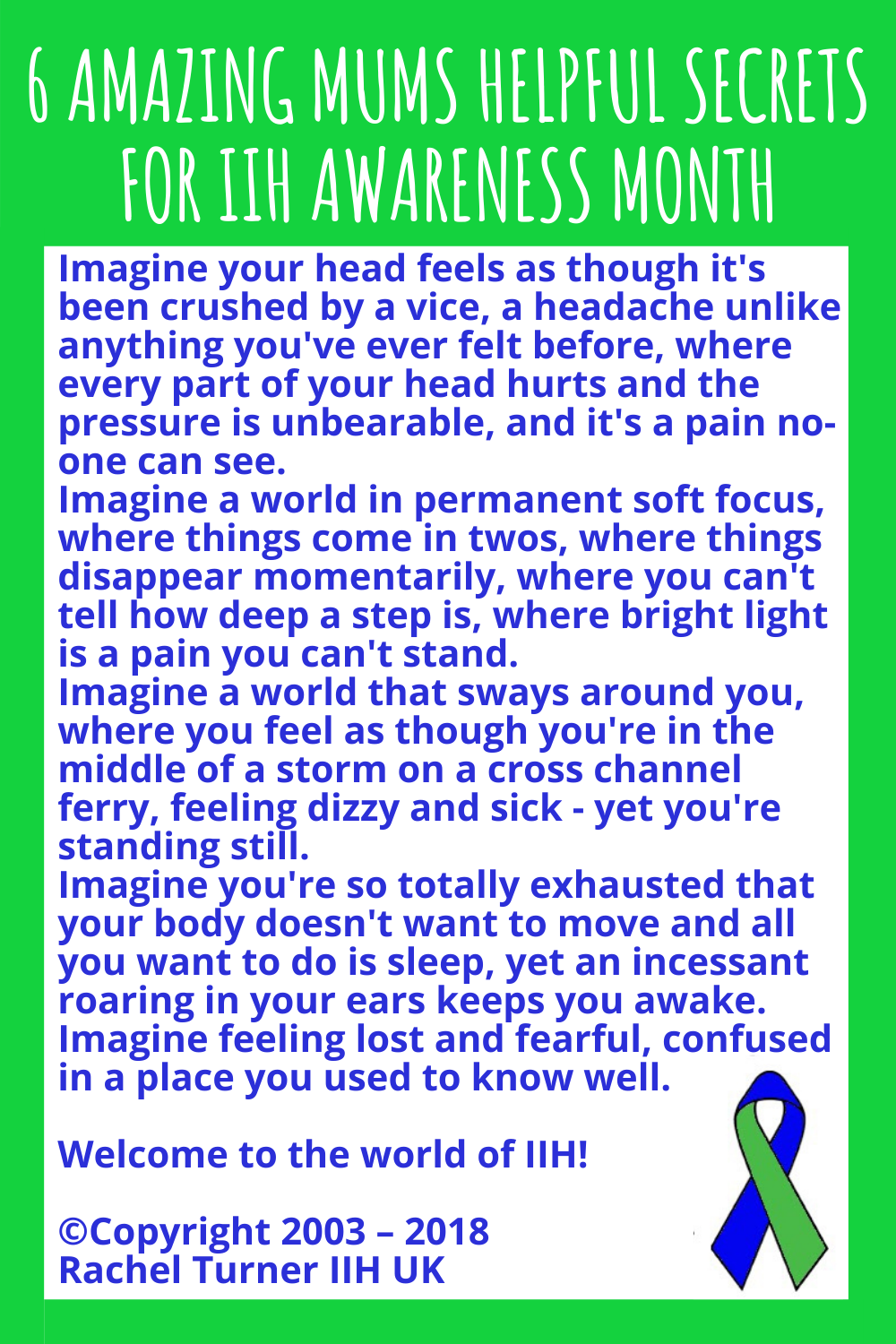
    As it’s IIH Awareness Month I’ve also included this descriptive piece written by one of a group of founding members of IIH UK, Rachel Turner.

    View fullsize

    Imagine your head poem written by Rachel Turner,,one of a group of founding members of IIH UK . This poem is written to raise awareness of the symptoms people with Idiopathic Intracranial Hypertension or IIH experience. This IIH awareness month we w…

    What Treatment Is Available?

    IIH is often treated with weight loss as, although not all people who are overweight develop IIH, there is a big link. Medical studies have shown an increased chance of developing IIH as weight increases. This leaflet from IIH UK explains more about this.

    Despite there being a strong link between weight gain and IIH, only one of our Mums spoke positively about weight loss, saying that it put her into remission for a long time. Another said that she didn’t “necessarily believe weight loss is the answer for this condition.“

    For more IIH Awareness Month detail I asked the mums about other treatment such as Topiramate, a common migraine treatment which most of the Mums are on and Diamox, which decreases CSF production but causes many side effects, which is why Sophie came off this medication.

    Surgery is also used to decrease CSF production, usually via shunts. I’ve had stent surgery but none of the others have had surgery, some due to other illnesses. Lumbar punctures can also be used to release excess CSF and 2 of these mums said they’ve had a countless LPs as they are unable to have surgery due to pre-existing conditions. 


    The relief from a LP is typically short lived as CSF is secreted from the choroid plexus at a rate of 25 mL/hour and consequently the volume removed in a so-called therapeutic tap is rapidly replaced

    — Jensen RH

    All treatments for IIH impact your quality of life, with the many side effects of medication or if you’re recovering from LPs and/or surgeries. The mums I spoke to for IIH Awareness Month have shared how they’ve been affected but we’re all different so our treatment is personal to us. Read this article from the British Medical Journal for medical insight into managing

    What Is It Like To Be A Mum With IIH?

    Claire has 2 children and was diagnosed in 2018 but had symptoms in 2015 whilst pregnant. She says that the worst part of having IIH is “not being able to take my girls out as much as I can never plan anything, as I don’t want to disappoint my youngest who doesn’t understand if mummy has to cancel things.”

    Leah has 3 young children and was diagnosed in the last 3 months of when I wrote this IIH Awareness Month Blog. She feels that she’s not “the fun mum who used to dance and sing. When my kids ask ‘can you play’?…and there little faces just drop.” But her “children are so good and do understand that I’m more unwell than I am well”.

    Keri has 3 adult children and was diagnosed two years ago but thinks she’s been suffering for 20 years or so with what she was told was migraine. She said “IIH has changed me. I am not as confident as I used to be.” As a working mum Keri has reasonable adjustments in place and says “if I’m feeling tired or have headaches” I can have office based time but “by Friday I am ready to collapse and I spend the whole weekend recouping.”

    Sophie has 2 children and was pregnant at time of writing. She was diagnosed in 2013/14 and says “when my head is so bad, I can’t open my eyes.” But after an LP, her husband and son notice she has higher energy levels and is less grumpy. 

    Having a support network of some kind is something I feel I couldn’t do without and as part of IIH Awareness Month we want others around us to stand by us. Sophie says she’s “happy I do have the support of my family and friends, even with the lack of understanding.” 

    Leah said “I do have a lot of support from my mum, she’s my rock. I would be lost without her and my mother in law.” Claire said “My partner has taken up a lot of the cleaning as I struggle with bending up and down too much as it makes my head feel weird.”

    Alexandra was diagnosed with IIHWOP in 2019 and has a young son. He knows that mummy can be sick quite a lot. She talked about the impact on her mental health, which is important to raise this IIH Awareness Month. She said “some days I find myself shouting for no reason… It breaks my heart because my toddler obviously doesn’t understand.” 

    People with IIH are at risk of developing mental health problems or have preexisting conditions worsen or reacting with medication. Sophie said ‘it’s left me alone and unaided by the world because know one understands. The condition changes our quality of life considerably.

    IIH Awareness Month: Being A Parent Will Make You Fight

    Due to the symptoms of increased pressure, our behaviour changes with some long term and some short term effects. We all manage this differently but it’s definitely harder to mother with this condition.

    It has affected my role as a parent in many ways and the mums I’ve spoken to for IIH Awareness Month feel the same. Our children, at almost any age, understand that we’re sometimes too unwell to play or do activities together. 

    As my boys are now teenagers, they understand that I struggle to chat on bad days. They’ve understood what surgery I’ve had and they look out for and after me. The common theme from speaking to these mums is that it’s our kids that keep us going.

    Claire’s the main carer for her disabled daughter so “doesn’t have much choice but to carry on.” She can have all her “symptoms at the same time and they can last for weeks and they affect everything. They restrict what she can do with her daughter but she can still be there “laying down as it helps with the nausea and dizziness.”

    Leah, who’s husband works 8 weeks on and 3 weeks off, feels that IIH has changed her family a lot. “My children do understand but they miss their old mum. If I’m having a good day I try to sing and dance and boom the music just so they know I am still here.” Dancing makes her head hurt but she still does it because she is a mum first. 

    Keri has adult children so can say she needs time out, however, she is still fighting an invisible illness. She said “I try not to complain about being in pain with either my head or my eyes or the fact that I’m tired because otherwise I’d be complaining all the time and that’s not fair on my family.”

    Sophie, who has young children, said “I don’t get extra help with anything. I was a mother first and I will be a mother last.” Despite this she says “I have to lay down from pure fatigue and migraines and hide and cry a lot but I don’t let anyone see.” She’s had one experience when she couldn’t remember her son’s name for a day. 

    For myself, having older boys, I’ve always been as honest as possible, my husband has helped me explain the surgeries to them. We’ve learnt strategies to help them cope with the ups and downs and we’ve developed stronger relationships. 

    I know I wouldn’t have fought to be here writing this today if I wasn’t their Mum. I spend most days in bed and miss out on going out as a family. So I’ve learnt to be more present and limit distractions when they come and see me, so that even short chats are meaningful. 

    In my opinion, Mums with IIH think, speak and interact with their kids with more intention. I believe we make the most of the good or better days that we have and that most of us try to hold on to the hope that one day there may be a cure! Sharing these stories in IIH Awareness Month, shows what makes us strong.

    The Takeaway

    IIH is a brain condition that causes debilitating symptoms due to raised pressure in the skull. It causes severe headaches, vision problems, and even loss of sight as well as many other symptoms.

    As it’s mostly younger women who develop this condition, I focused this blog on mums for IIH Awareness Month as I wanted to share the impact IIH can have on the role of a mother. 10% of sufferers are men however.

    Some of us have a stressful time trying to get an actual diagnosis. Mums that I’ve spoken to have had symptoms for years before being diagnosed. Keri and I are both examples of being misdiagnosed with migraine. 

    Being a mum with IIH is different for each of us. For those with young children there’s additional mum guilt, although we all get it, because their children are active. Alexandra said it’s “very sad to me as he is just a toddler and I should be able to play and do fun things all of the time but I just can’t.”

    Having a support network of some kind is something I feel I couldn’t do without. Leah said “I do have a lot of support from my mum, she’s my rock. I would be lost without her and my mother in law.” Claire said “My partner has taken up a lot of the cleaning as I struggle with bending.”

    I’d like to thank everyone trying to raise the profile of IIH Awareness Month by contributing to this blog and sharing the difficulties we face. Many of us find balance over time. As Sophie said “this is a lifelong condition” that makes us feel that we’re not being ‘us’ anymore”.

    Alexandra said “There are days I cannot even get out of bed…I feel horrible because I can’t always play and be the fun mummy I would love to be.” Leah sums up “Most of us are constantly wondering what we did to deserve this, but that’s life, we get what’s thrown at us.”

    IIH changes us as women, mothers, partners and the relationships we have with our children and family. We want people to take notice that this is a condition we will live with for our whole life and many of us lose vision to some degree and can even become blind. It really is not just a headache! 

    Stay safe,

    Laura 💚💙

    Click here to find out more about me

    To help us raise awareness please share this blog on your social media with friends and use #IIHAwarenessMonth. We’d love to be able to raise money for IIH UK so please add the donate button if you share on Facebook or donate now by clicking the link below and making your one off donation.


    ✋ Hey there! I hope you’re feeling stronger now. If so, sharing the love will help me help other mums with chronic invisible illnesses.⬇ Hit one of those sharing buttons or save these images to Pinterest and I will do a bed-bound happy dance – there’s an image for you!

    #block-yui_3_17_2_1_1599924948898_114996 .sqs-gallery-block-grid .sqs-gallery-design-grid { margin-right: -20px; }
    #block-yui_3_17_2_1_1599924948898_114996 .sqs-gallery-block-grid .sqs-gallery-design-grid-slide .margin-wrapper { margin-right: 20px; margin-bottom: 20px; }