
Tag: migraine

  • An Astonishing Look Into A Day With Chronic Illness

    An Astonishing Look Into A Day With Chronic Illness

    An Astonishing Look Into A Day With Chronic Illness

    Ever wondered what a day living with chronic illness and disability looks like? Today I’m taking you on an astonishing look into the highs and lows that can occur day to day, as well as some insight into the strategies that work for me.

    From the moment I wake up, I’m already facing barriers. My chronic illnesses make it hard to get out of bed, often leaving me exhausted and in pain. Every day is a balancing act where I have to be mindful of my energy levels and make sure that I’m taking time to rest. 

    This behind the scenes, focused, look into a day of my life with chronic illnesses, pain, and fatigue is part of a Linkup blog organised by Sheryl Chan from A Chronic Voice. Sheryl has written these questions which I’ve answered to write this blog.  


    An Introduction To My Chronic Illnesses

    In 2009 I was diagnosed with migraine disease after 20 years of undiagnosed attacks. My migraine became chronic in 2013, diagnosed when you have 15+ headache days a month. Every weekend was ruined by migraine attacks. 

    In early 2014 I fell ill with migraine-like symptoms, which my doctors thought was a month-long migraine attack. When it didn’t show signs of stopping, I noticed whooshing in my ears. My GP told me this new symptom was pulsatile tinnitus. I knew at once this was more than an extended migraine attack.

    My local neurologists wouldn’t look into this, and feeling frustrated, I sought specialist treatment in Cambridge. I was diagnosed with Idiopathic Intracranial Hypertension or IIH, a rare brain disease, 9 months after my symptoms started. 

    IIH medication didn’t help and it became apparent that I had an atypical presentation of this rare disease. The Cambridge specialists were working on a trial treatment for people with the same outlook as myself but I’d missed the deadline. 

    I had to wait another year for this controversial surgical treatment which I found incredibly stressful but had the support of my GP. Meanwhile I tried every migraine preventative to appease my various neurologists, who were all against my treatment plan, but to no avail. 

    I became depressed and had anxiety because of grief from losing my Career and active life, disagreements with doctors, as well as worries about experimental treatment. If you’d like to know more about my IIH treatment, please read this blog.

    What My Day Looks Like 

    When I first wake up I am confronted with the pain in my face that I live with constantly, this quickly translates to nausea. My thoughts quickly go to when I can take my medications to combat the worst symptoms, which I have to take with food. 

    Sometimes I wake very early because the pain is off the charts and I have to take a dose of Oramorph to get me through until breakfast. This is the next barrier as I can’t function until my medications kick in. So my husband, Joel, makes me breakfast and brings it to me in bed. Joel prioritises caring for me into his busy morning. Read Joel’s point of view as my Carer here. 

    My morning is then dedicated to rest as I take many heavy duty pain relief and preventative medications. I usually fall back to sleep while watching television, either a series of snoozes or a block of sleep, depending upon how high the pain is. 

    On the highest pain days my body simply can’t rest enough to sleep so I will force rest with meditation which is a brilliant restorative practice. So even if I can’t sleep I get some complete rest, often with the help of an oramorph dose. Thankfully on low pain days I don’t even think about taking any oramorph as sleep is enough of a boost on its own.

    My Carer, Sam, arrives late morning and brings me a cup of herbal tea and opens my curtains, to help me wake up at noon. Joel does this at the weekend as it’s vital in helping me become operational. They also get clothes out for me so I don’t have to bend down as this increases my intracranial pressure. 

    Sam or Joel bring me lunch at 1:30pm so I can take my next lot of medicine, both helping me gather enough energy to shower. Some days are easier than others but I use a shower stool to save energy for getting dressed. It’s painful and tiring to wash my hair so I only do this once a week. 

    On my better days, I’m usually functioning at my best around 3-6pm, so this is when I usually focus on writing my blogs, coaching journal and self-help downloads. I also write for patients at Teva’s Life Effects which you can find here.

    My favourite part of the day is spending time with my family when I manage to make it down to the sofa for a change of scenery. This routine only started at the beginning of 2023 as I’ve been building up my stamina by swimming regularly for over a year. 

    I head down around 6pm and curl up on the long seat, sometimes napping. Then we eat dinner and watch TV as a family which has really helped my mental health as I feel more connected. 

    I stay down until about 9pm when I take my nighttime medication which is even stronger than my morning regime. I wind down watching TV in bed with Joel, when we get a chance to hold hands and snuggle. 

    When I actually settle down to sleep, I play Wordle and other puzzles to help keep my brain working. Then I settle down, wearing my frozen ice hat that helps soothe my pain so I can sleep as my pain is always at its worst at night. 

    An Eye-opening View Of A Day Living With Chronic Illness

    What I consider a daily self-care must do.

    Writing about what I’m grateful for in my journal helps me remember the positives, even on days that are awful. Living in constant pain is so exhausting and can be very negative if the pain gets on top of you. 

    Are you are able to do any exercise? If so, what do you enjoy and does it help with managing your pain?

    I started swimming in 2022, when my social worker organised for my Carer to take me. I’ve gradually built up to twice weekly. I find swimming helps my pain levels, unless I can’t get out of bed. I have to take Oramorph when I’ve finished, as showering and dressing wipes me out, despite having help.

    Things that help me de-stress in my everyday life.

    Things that improve my mental health are essential oils, doing my make-up, organising anything, and swimming. I have to pace myself so everything takes longer than someone without chronic illness.

    The household chore I have the most trouble with.

    Everything! Luckily I have a Carer and cleaners but I’m gradually doing little chores now that I’m downstairs more, such as plumping cushions, drawing curtains and wiping down the surfaces in the kitchen. The worst chore is when the hoover comes out (I don’t do it) but I struggle with the noise.

    What’s breakfast, lunch and dinner typically like. Any diet protocols?

    My nausea and pain levels dictate my diet and I crave certain foods whilst my body is going from zero to functional. I always have toast and marmalade for breakfast, and this is my go-to when I’m in lots of pain. For lunch I usually have a sandwich and fruit. Dinner is quite varied as this is my best time of day.  

    I went vegan in 2021 which I believe has contributed to my overall health being slightly improved. I plan the menu for the week so my family, who are pescatarians, generally eat vegan meals as we eat lots of vegetables, lentils or chickpeas and some meat substitutes. Sam preps or cooks a meal in the slow cooker and Joel finishes it off and serves so it’s a team effort.

    People I see most often and my favourite activities to do with them.

    Sam comes for 2 hours every weekday and Joel works at home so I love having a good natter and a giggle, although this increases my pain levels. I love going out with my family on my best days, which is usually quite spontaneous to make the most of low pain levels. 

    Joel is my best friend so we plan date nights at home, visits to the village pub and live music and comedy in the last few years. Music has always been our thing so this is vital to our healthy relationship, although I know I will put myself into a week or so of high pain afterwards.

    Do you have any pets and how are they a part of your life?

    Having rescue cats has rescued me since I became ill in 2014. The wonderful Salmiakki and Finleaf came to live with us in 2019. Salmiakki (a Swedish liquorice) owns me. He knows when I’m in high pain and demands to sit on me so I rest. They are house cats so they always keep me company. 

    If I could leap out of bed pain free for ONE day within my current environment and circumstances, I would…

    tidy and clean the whole house as I’m a control freak. Letting other people organise my house and leaving things that aren’t as tidy as I’d like, has been one of the hardest things to learn since getting sick. I would also see my best friends more often.

    Is there anything else you’d like to share about daily living with chronic illness/disability?

    I hope people will realise that we never know what someone else is really going through. Whether it’s how much help I need to get going each day, sleeping all morning or going to bed wearing an ice hat, I’m in pain for every second. Some of the time it’s barely noticeable but I feel it dragging me down. 

    By sharing what my day to day life is like I hope I can raise awareness of the bigger picture as people only see snippets of me online or see me on my best days in person. I am not sharing this for pity or sympathy and I am not complaining.

    The Takeaway

    Writing about my day living with chronic illness has been quite shocking to me to see how much help I still need even on the days when I’m able to manage more. I feel strongly the need to celebrate the connectivity I have with my loved ones, 

    Writing this has made me see how much progress I’ve made since I last wrote about my chronic pain conditions. However, my progress is still very small which has reminded me that I still need care every day to function.

    I hope that you have found this blog an insight into life with chronic pain. I would love to hear about what surprised you or if you have any questions about anything I’ve mentioned. Just leave a comment below. 
    #block-d5972ebefb99f0449a79 .sqs-gallery-block-grid .sqs-gallery-design-grid { margin-right: -20px; }
    #block-d5972ebefb99f0449a79 .sqs-gallery-block-grid .sqs-gallery-design-grid-slide .margin-wrapper { margin-right: 20px; margin-bottom: 20px; }

    ✋ Hey there! I hope you’re feeling stronger now. If so, sharing the love will help me help other mums with chronic invisible illnesses.⬆  Hit one of those sharing buttons or save these images to Pinterest and I will do a bed-bound happy dance – there’s an image for you!

  • What To Accept After Years Of Intracranial Hypertension Treatment

    What To Accept After Years Of Intracranial Hypertension Treatment

    What I Need To Accept After Years Of Rare Intracranial Hypertension Treatment

    Rare Disease Day 2022 is always on the 28th February, so at this time of year I tend to reflect on the treatment I’ve had for the rare brain disease I have – Idiopathic Intracranial Hypertension (IIH). 

    I’ve been treated by a specialist team in Cambridge for the past 7 years. They’ve developed rare treatment plans for patients, who like me, often present with atypical IIH symptoms. Sadly, the treatment options they’ve developed have been exhausted in my case.

    I spoke to my neuroradiologist about this last month and he asked about the results following my first procedure, so I re-read my notes and the hopeful blog I’d written back then. I now have to accept that my symptoms haven’t resolved as I’d hoped and this blog could help.

    The surgical team has established unorthodox medical care that most neurologists consider controversial. This affected the support I received, so I had to learn to advocate for the care I wanted. Medical journals now publish more on these treatments, giving me hope. 

    In this blog I’m going to look at:

    • My Background Story Of Idiopathic Intracranial Hypertension 

    • What I Wrote About How I Felt After This Procedure 

    • The Results Of My Following Treatments 

    • What I Am Feeling After Completing My Treatment Plan

    My Background Story Of Idiopathic Intracranial Hypertension 

    In January 2014 I became ill and was diagnosed with chronic migraine, but after years of migraines I had doubts. I grew aware of a symptom I’d never experienced before, a whooshing in my ears. I researched Pulsatile Tinnitus (PT) and my family doctor confirmed it.

    I found an ENT surgeon who specialises in PT and he believed I had IIH. But my symptoms don’t fit typical diagnosis factors, so with the support of my wonderful family doctor, I had to advocate for 18 months to get their Intracranial Hypertension treatment. 

    IIH, it’s symptoms and my full story are detailed on this blog. My main symptom is constant head and facial pain that’s mostly right sided and mobility issues due to imbalance. I also have brain fog, nausea, photophobia (light sensitivity) and PT.

    In October 2014, my IIH diagnosis was confirmed with a lumbar puncture and a CT venogram (scan with dye). This showed narrowed veins at the skull base and venous sinus stenosis, where the large vein in the brain is narrowed. This causes fluid build up in the head. 

    IIH is a rare disease that affects 1-3 in 100,000 people. My scans identified Transverse Venous Stenosis causing constricted outflow in the veins at the back of my skull. This and the lack of papilledema puts me in the group of 6% of all IIH patients with this presentation. 

    Their Idiopathic Intracranial Hypertension treatment is controversial with most neurologists. IIH is usually accompanied by Papilledema, which if left untreated can lead to loss of vision. The pressure reading from a lumbar puncture is usually very high, mine wasn’t. 

    When I’d mention the Cambridge team or IIH, my local neurologists turned me away. I found one who would see me, but she still didn’t agree with the team’s radical surgical plan to remove some bone to improve venous outflow in my neck (see below for details).

    This sounds outrageous but my pain and standard of living was so debilitating that I’d try anything for relief. The plan was brain and spine surgeries and stenting the narrowed vein in my brain. This article explains the link between venous sinus stenosis, PT and IIH.

    Reflecting On The First Procedure Of My Treatment Plan

    After a very long year of waiting, the team’s neuroradiologist was able to perform my first Intracranial Hypertension treatment. I had a cerebral angiogram and venoplasty as an outpatient procedure to see if surgery to expand a narrowed vein would be beneficial. 

    They thread a catheter up to the blood vessels in the neck that supply the brain, imaging and measuring the pressure inside my veins. Then they inflate a balloon in the vein (venoplasty) to monitor how it responds to decompression over a week. 

    I noticed a difference immediately and by the time I went back to the ward I was a different person to the one admitted that morning. I had lower pain levels, no nausea and a clearer head. The difference was visible and as I chatted, Joel, my husband, said “you’re Laura again”. 

    The improvement continued over the following days. I was able to walk the stairs, which I hadn’t done for 12 months, I didn’t need any oramorph, which I’d been taking 2 or 3 times a day and I reduced my other pain killers temporarily.

    My PT and nausea returned first and a week later I woke up in my usual state of brain fog and pain. My surgeon was pleased with the results of the venoplasty. Although temporary they clearly showed I had restricted venous outflow and that surgery should be beneficial.

    What I Wrote About How I Felt After This Procedure 

    I’d been told not to be disheartened if the symptoms reappeared the following week but it was frustrating to return to debilitating pain. However, I was pleased that this proved I didn’t just have chronic migraine.

    At the time I wrote “I am… pretending I’m ok, feeling bad for moaning about hurting, crying and letting people down and not being able to do things with my family… [as] the pressure [builds again]. 

    [I’m] missing out on… living life… trying to explain why everything takes so long and feeling worthless… knowing that the freedom of mobility is drifting away. [I’m] crying and waiting for that time bomb of pain to build so much that [I] can’t take anymore.

    I have meditated, eaten, napped and had a few pep talks from friends and my husband… There have been tears today but I’ve been reminded that I [will] see my amazing boys grow up… with my best friend [Joel] of 18 years. 

    I have hope that there might be light at the end of this very, very long tunnel… I have amazing friends and family that are always there… even though I feel I’ve let [them] down by only being better for a few days… [when] I was so tired I just slept! 

    I am back making jewellery… reminding myself that I CAN still do things that matter despite feeling like I’ve been run over by a truck after drinking… whiskey.” My true friends have stuck by me and Joel still gives me pep talks. He and the boys keep me going each day.

    The Results Of My Following Treatments 

    It wouldn’t be a complete reflection if I didn’t share the Idiopathic Intracranial Hypertension Treatment I’ve had since that first procedure. This blog has been more emotional than I thought because it’s shown me how poorly I was at the start of this journey. 

    I’ve had venoplasty procedures and many CT venograms. These show how the jugular vein passes through a small space between two bony structures, the styloid process and lateral mass of the C1 cervical spine. In my case the jugular vein is narrowed and flattened. 

    The anatomy of these areas are shown in these images.  

    This is my IIH story outline of the surgeries I’ve had: 

    1. Styloidectomy – removal of a small bone fragment that sticks out of the skull, behind the ear.

    2. Stenting on the right side of the transverse venous sinus.

    3. C1 mass removal of the right transverse process.

    4. Re-stenting the right transverse sinus due to a compromised stent. 

    5. C1 mass removal of the left transverse process.

    6. Stenting on the right side of the transverse venous sinus. 

    With each surgery I’ve seen some improvement, most notably my cognitive ability. My final surgery, in 2019, has had the most impact. My balance improved significantly and a month on, I managed a day out with my family, using a wheelchair, for the first time since 2014.

    I’ve hoped for a life without constant pain since 2014. My symptoms improved with each surgery. Sadly I still suffer daily but there are positives from my treatment, mostly being able to be a good mum & wife.

    What I Am Feeling After Completing My Treatment Plan

    It’s been emotionally challenging reliving my IIH patient stories again. There’s been many tears as I think back to the hope I had for this treatment, a normal life off of the merry-go-round of constant pain. I’d naively counted on my surgeons to fix me, so the reality is crushing. 

    When the first venoplasty procedure had clear results, confirming I’d benefit from venous stenting surgery, I felt optimistic. Every surgery improved my condition but I’d gradually worsen each time. 

    Reading a blog from the start of this journey shows how challenging communication was for me. I’d be stuck there without surgery which would have broken my family. As I complete my treatment, the harsh facts are that I suffer daily but I am able to be a good mum and wife

    This 2012 US case study states that “Intracranial venous hypertension may result from… compression of the jugular veins at the skull base. Although rare… [it’s ] important to recognize [this] because stenting…may actually exacerbate the outflow obstruction.“

    My surgeon stated this could happen with stenting. He described it as removing a blockage at the top of a hose pipe, when it’s squashed lower down. The water builds up, leading to increased pressure. 

    My scans still show narrowed veins at the skull base but I’ve had all bone surgeries recognised for treating IIH. My surgeon can only see one possible surgery to relieve pressure here but it isn’t seen as a viable treatment for IIH. I’m frustrated by having to forget this option. 

    All involved are disappointed about completing this treatment plan without the success we’d hoped for. But PT took me down this path, and I’d hoped that this symptom would be resolved. As this is mostly the case, then I can count this part of the treatment a success. 

    This has reminded me how my quality of life has improved because of my Idiopathic Intracranial Hypertension treatment plan. The positive outcomes are:

    • The cognitive change I’ve experienced is quite dramatic. 

    • My mobility has improved so much I no longer fall.

    • I can walk on one level of the house, without mobility aids.

    • I don’t experience daily dizziness or vertigo 

    • My phonosensitivity is less invasive

    Sadly, my head pain remains constant, despite initial improvement after surgery. My high pain levels are disruptive so I still spend much time in bed. It still takes days for me to recover from any activity, even going downstairs, which can feel oppressive. However, over time I’ve learnt how to priortise for better life balance.

    I’ve created this free wellness planner to help you prioritise for better life balance too. This is also a taster of the the Thrive Not Just Survive Journal, for mums with invisible illnesses coming out soon. Simply click on this link to sign up for your free copy. Please feel free to ask me any questions you have about using this resource.

    It’s been an exhausting journey but looking back I take the positives, such as my ability to build connections, from my treatment as I move forwards. My surgeon has suggested a doctor sympathetic to their work, who I’m working with on the next stage of my treatment plan. 

    It’s scary saying goodbye to familiar territory as I complete treatment in Cambridge. I’m reassured and hopeful after speaking to my new doctor, but I’m anxious and apprehensive about what I face ahead.

    P.S. If you’re a skim reader, catch up here –

    I’ve been reflecting on my unusual IIH or Intracranial Hypertension treatment. This rare brain disease causes debilitating pain, mobility problems, brain fog and more. I re-read a hopeful blog I’d written in 2015 after my first procedure, when my husband said “you’re Laura again” as soon as he saw me. As this treatment ends I accept my symptoms haven’t all resolved but there are positives I can take on into the next part of my journey. 

    #block-yui_3_17_2_1_1647542983744_17509 .sqs-gallery-block-grid .sqs-gallery-design-grid { margin-right: -20px; }
    #block-yui_3_17_2_1_1647542983744_17509 .sqs-gallery-block-grid .sqs-gallery-design-grid-slide .margin-wrapper { margin-right: 20px; margin-bottom: 20px; }

    ✋ Hey there! I hope you’re feeling stronger now. If so, sharing the love will help me help other mums with chronic invisible illnesses.⬇  Hit one of those sharing buttons or save these images to Pinterest and I will do a bed-bound happy dance – there’s an image for you!

  • 6 Amazing Mums Helpful Secrets For IIH Awareness Month

    6 Amazing Mums Helpful Secrets For IIH Awareness Month

    6 Amazing Mums Helpful Secrets For IIH Awareness Month

    When I was diagnosed with Idiopathic Intracranial Hypertension (IIH) in 2014, I worried about the impact on my boys’ lives. They were 10 and 11 and it was hard on them. I was lucky as my husband stood by me as we adapted our parenting.

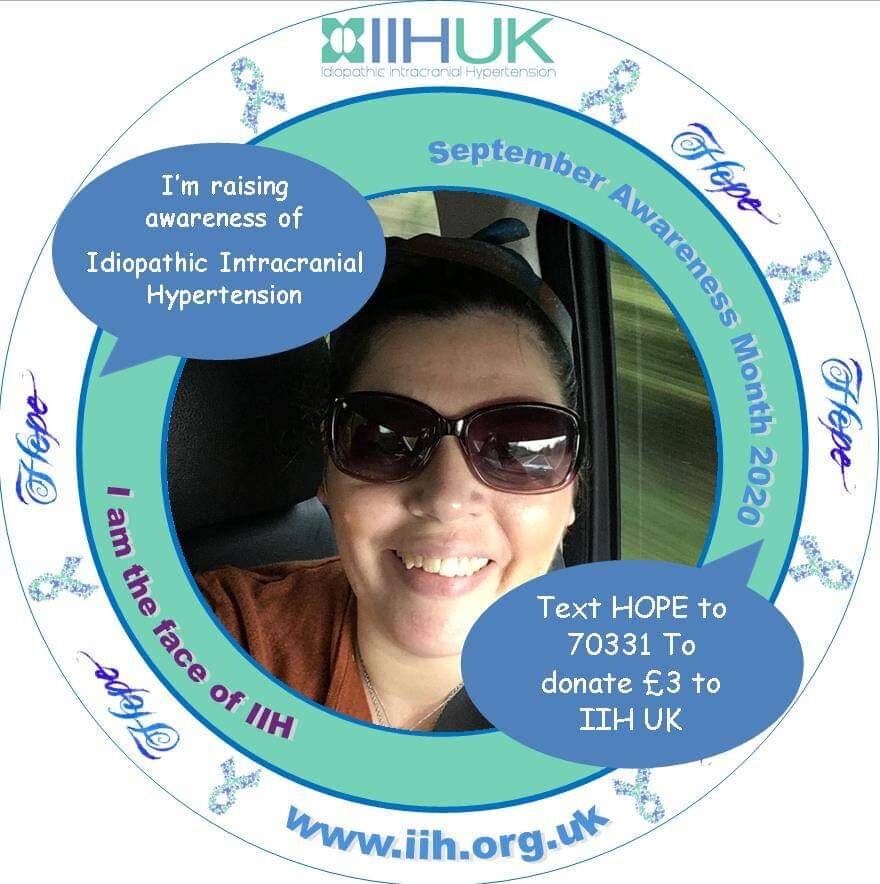
    But every parent with this condition has a different experience, for September’s IIH Awareness Month, I asked 6 amazing mums from the IIH UK Facebook support group, about their secrets as a mum with Idiopathic Intracranial Hypertension to help other mums in a similar position. 

    We’ve done this in the hope that we can fundraise for IIH UK so we’re sharing how IIH affects us as and our children to raise awareness of this rare brain disease. We’d be very grateful if you could make a donation to IIH UK to fund research.

    This invisible illness affects our role as a parent but many of us push through the pain, hiding how we feel from friends and family. One mum I spoke to said that when she’s in so much pain she cries, she hides to avoid  her children seeing her like that. We’ve spoken up this IIH Awareness Month with the hope of sharing the secrets of being a mum with IIH life.

    What Is IIH And Who Gets It?

    IIH occurs when levels of cerebrospinal fluid (CSF), which plays an important role in cushioning the brain, gets too much and the skull can’t expand so the pressure increases. The meaning of the term Idiopathic Intracranial Hypertension is:

    • Idiopathic – unknown cause

    • Intracranial – in the skull

    • Hypertension – high pressure

    This condition is found more commonly in women but does affect about 10% of men. It’s common in teens and young women, but can affect children and adults of any age. IIH occurs in 1-3 people in every 100,000. This is higher in those who are obese.

    The ladies I’ve asked, Sophie, Keri, Leah, Alexandra and Claire and myself range from 21 up to two of us, including myself, being in our forties. Two ladies have been diagnosed in the last year, with many feeling we had symptoms before our diagnosis. 

    During IIH Awareness Month, I believe it’s important to use this platform as a voice for these mums to share their experiences and thoughts about parenting with IIH. By sharing what we live with each day we can show our similarities and differences.  

    How Is IIH Diagnosed And What Are The Symptoms?

    IIH Awareness Month is about raising awareness of this condition. To be diagnosed with IIH someone needs to have brain scans and a lumbar puncture (LP), also called a spinal tap. These 5 things to rule out other conditions and confirm IIH:

    1. Papilloedema (swelling of the optic (eye) nerves 

    2. Normal neurological examination (sixth nerve palsy causing double vision is allowed)

    3. Normal brain imaging. This is usually a CT or MRI scan

    4. Normal brain CSF analysis

    5. Elevated lumbar puncture with an opening pressure, usually above 25cm

    As diagnosis requires an LP or spinal tap, this can be quite distressing. Read this leaflet for more information about the procedure.

    Sophie was the only mum here to have had a negative experience with an LP. She said “the first one I ever had knocked me for six. I ended up in hospital for a week… due to too much pressure removed. It was very hard on my boy because he’d never been away from his mummy.”

    Papilloedema occurs when CSF pressure compresses the nerves supplying the eye. This affects vision and may lead to vision loss, meaning emergency treatment, such as shunt surgery, may be needed to save vision. Please read this leaflet from IIH UK about shunts.

    I asked the ladies about their 3 worst symptoms. This differed between each of us, with a few ladies saying their symptoms differ daily. Alexandra said “My symptoms differ from day to day, however I have a handful of symptoms that affect me most.”

    All six of us said that headaches or ‘migraine’ was one of our worst symptoms. Sophie described it as: “Migraines, where I physically can not open my eyes or move my head. [Migraine] has also caused me to have memory loss from the pain.”

    She goes on to say “I find that this condition comes with a problem. People stereotype it as headaches, and nothing else, [saying] ‘go take a paracetamol, you’ll be fine!’. I hate that, when my head is so bad, I can’t open my eyes.”

    However 6% of people with IIH never have papilloedema and headaches are more telling as to their diagnosis. This is called IIH Without Papilloedema (IIHWOP) and is harder to diagnose. I was given this diagnosis in 2014. You can read about my diagnosis story here.

    Another common symptom is brain fog, feeling like you’re spaced out, which is described well by Keri: “I drive my children nuts as I start a conversation and then just stop, as I can not remember what I was saying.” This and having difficulty understanding words is called aphasia. 

    For IIH Awareness Month I want to share the mostly common symptoms other than headache and Papilloedema, that the mums shared with me:

    • Vomiting and nausea

    • Memory loss or brain fog

    • Pulsatile Tinnitus – a whooshing or throbbing in the ears (in time with the heartbeat)

    • Dizziness and Vertigo

    • Black outs

    • Temporary Eyesight/Vision problems

    • Tunnel Vision

    • Hearing sensitivity

    • Neck pain

    • Eye pain, described as “stabbing pain behind the eye”

    • “loss of feeling in my legs and arms”

    Alexandra spoke about her worry about “The loss of feeling and vision [being] quite dangerous, especially being a mother. I don’t have any sign that the loss is coming on so things as simple as walking downstairs with my son can be potentially dangerous!”

    Watch this short video about the symptoms made by IIH UK

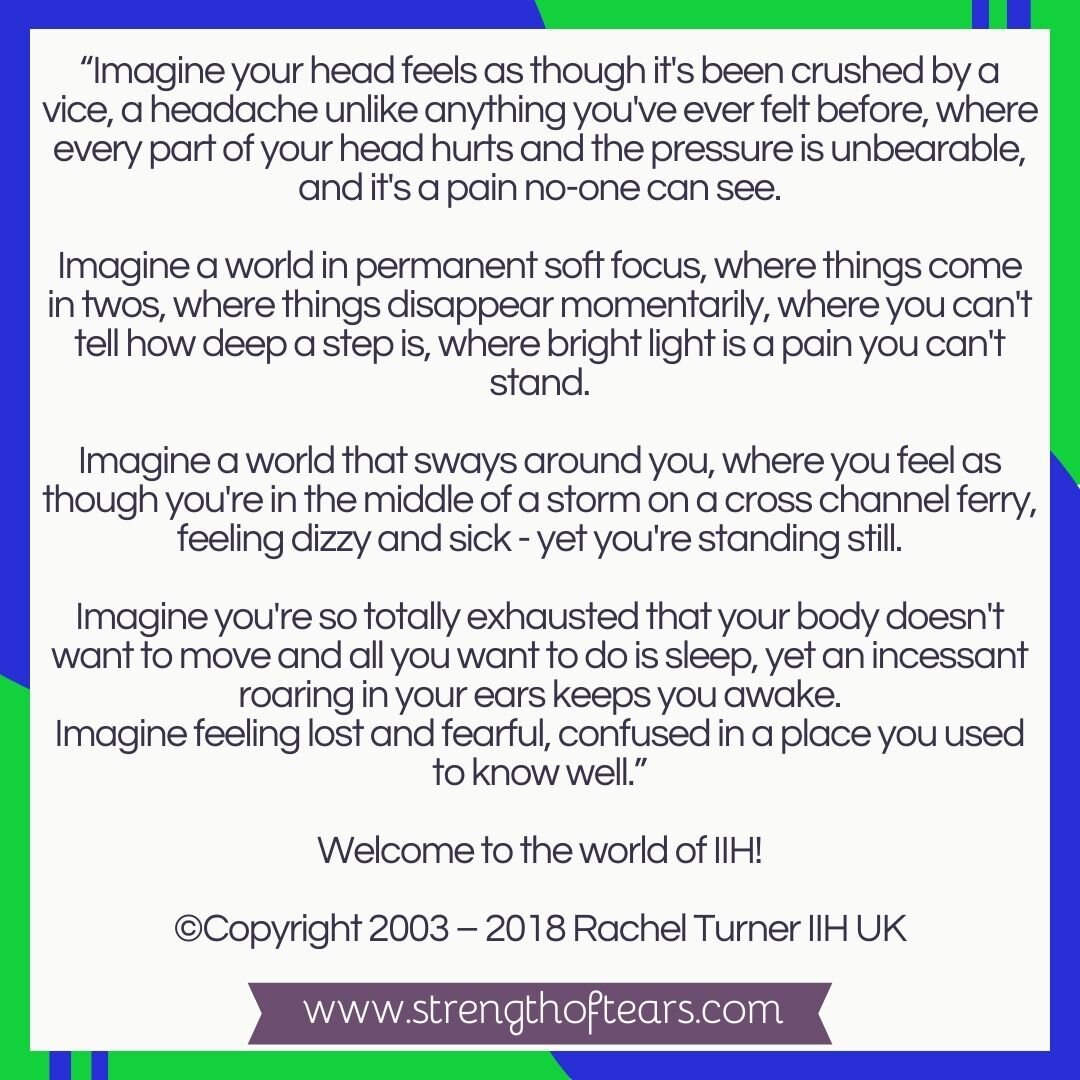
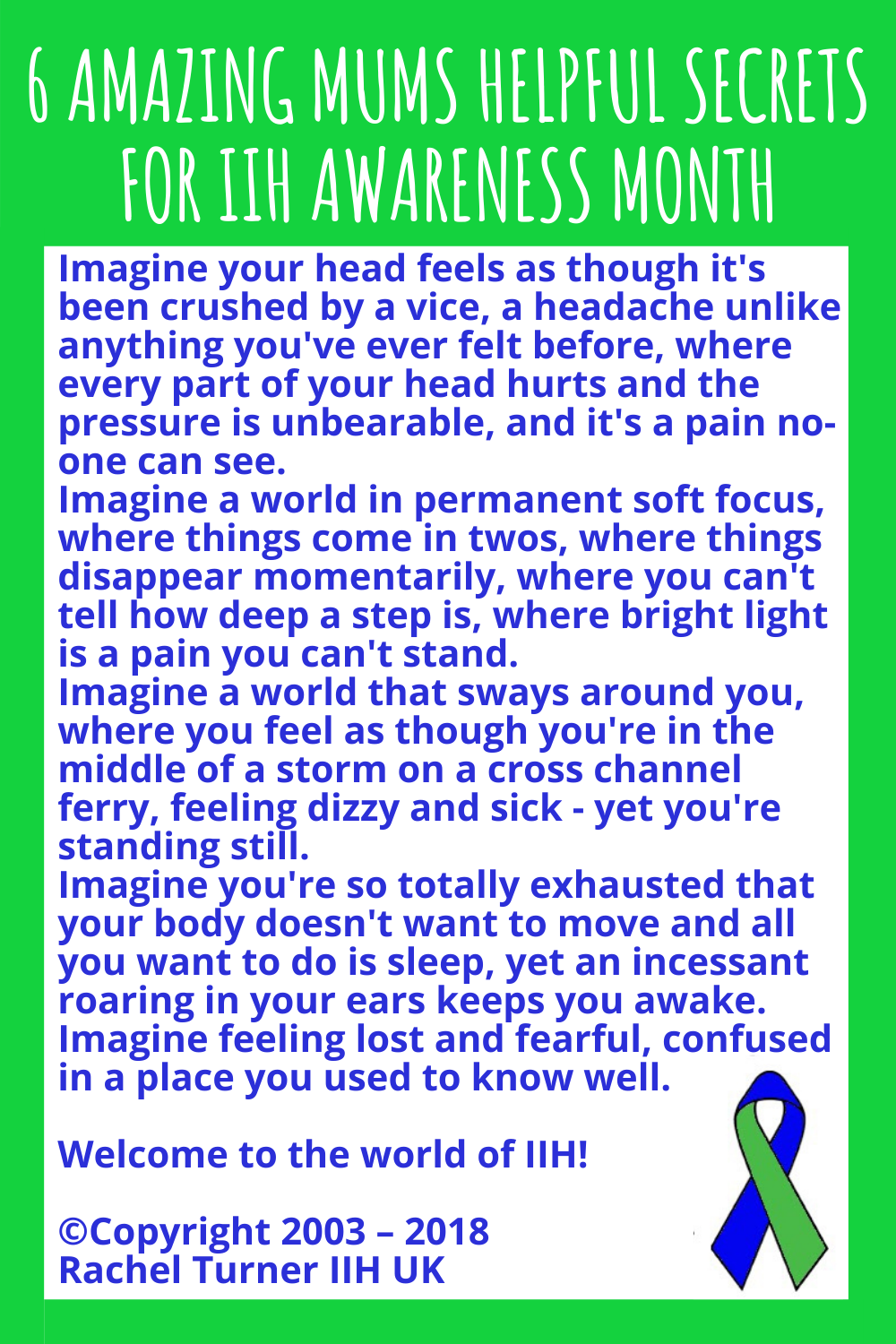
    As it’s IIH Awareness Month I’ve also included this descriptive piece written by one of a group of founding members of IIH UK, Rachel Turner.

    View fullsize

    Imagine your head poem written by Rachel Turner,,one of a group of founding members of IIH UK . This poem is written to raise awareness of the symptoms people with Idiopathic Intracranial Hypertension or IIH experience. This IIH awareness month we w…

    What Treatment Is Available?

    IIH is often treated with weight loss as, although not all people who are overweight develop IIH, there is a big link. Medical studies have shown an increased chance of developing IIH as weight increases. This leaflet from IIH UK explains more about this.

    Despite there being a strong link between weight gain and IIH, only one of our Mums spoke positively about weight loss, saying that it put her into remission for a long time. Another said that she didn’t “necessarily believe weight loss is the answer for this condition.“

    For more IIH Awareness Month detail I asked the mums about other treatment such as Topiramate, a common migraine treatment which most of the Mums are on and Diamox, which decreases CSF production but causes many side effects, which is why Sophie came off this medication.

    Surgery is also used to decrease CSF production, usually via shunts. I’ve had stent surgery but none of the others have had surgery, some due to other illnesses. Lumbar punctures can also be used to release excess CSF and 2 of these mums said they’ve had a countless LPs as they are unable to have surgery due to pre-existing conditions. 


    The relief from a LP is typically short lived as CSF is secreted from the choroid plexus at a rate of 25 mL/hour and consequently the volume removed in a so-called therapeutic tap is rapidly replaced

    — Jensen RH

    All treatments for IIH impact your quality of life, with the many side effects of medication or if you’re recovering from LPs and/or surgeries. The mums I spoke to for IIH Awareness Month have shared how they’ve been affected but we’re all different so our treatment is personal to us. Read this article from the British Medical Journal for medical insight into managing

    What Is It Like To Be A Mum With IIH?

    Claire has 2 children and was diagnosed in 2018 but had symptoms in 2015 whilst pregnant. She says that the worst part of having IIH is “not being able to take my girls out as much as I can never plan anything, as I don’t want to disappoint my youngest who doesn’t understand if mummy has to cancel things.”

    Leah has 3 young children and was diagnosed in the last 3 months of when I wrote this IIH Awareness Month Blog. She feels that she’s not “the fun mum who used to dance and sing. When my kids ask ‘can you play’?…and there little faces just drop.” But her “children are so good and do understand that I’m more unwell than I am well”.

    Keri has 3 adult children and was diagnosed two years ago but thinks she’s been suffering for 20 years or so with what she was told was migraine. She said “IIH has changed me. I am not as confident as I used to be.” As a working mum Keri has reasonable adjustments in place and says “if I’m feeling tired or have headaches” I can have office based time but “by Friday I am ready to collapse and I spend the whole weekend recouping.”

    Sophie has 2 children and was pregnant at time of writing. She was diagnosed in 2013/14 and says “when my head is so bad, I can’t open my eyes.” But after an LP, her husband and son notice she has higher energy levels and is less grumpy. 

    Having a support network of some kind is something I feel I couldn’t do without and as part of IIH Awareness Month we want others around us to stand by us. Sophie says she’s “happy I do have the support of my family and friends, even with the lack of understanding.” 

    Leah said “I do have a lot of support from my mum, she’s my rock. I would be lost without her and my mother in law.” Claire said “My partner has taken up a lot of the cleaning as I struggle with bending up and down too much as it makes my head feel weird.”

    Alexandra was diagnosed with IIHWOP in 2019 and has a young son. He knows that mummy can be sick quite a lot. She talked about the impact on her mental health, which is important to raise this IIH Awareness Month. She said “some days I find myself shouting for no reason… It breaks my heart because my toddler obviously doesn’t understand.” 

    People with IIH are at risk of developing mental health problems or have preexisting conditions worsen or reacting with medication. Sophie said ‘it’s left me alone and unaided by the world because know one understands. The condition changes our quality of life considerably.

    IIH Awareness Month: Being A Parent Will Make You Fight

    Due to the symptoms of increased pressure, our behaviour changes with some long term and some short term effects. We all manage this differently but it’s definitely harder to mother with this condition.

    It has affected my role as a parent in many ways and the mums I’ve spoken to for IIH Awareness Month feel the same. Our children, at almost any age, understand that we’re sometimes too unwell to play or do activities together. 

    As my boys are now teenagers, they understand that I struggle to chat on bad days. They’ve understood what surgery I’ve had and they look out for and after me. The common theme from speaking to these mums is that it’s our kids that keep us going.

    Claire’s the main carer for her disabled daughter so “doesn’t have much choice but to carry on.” She can have all her “symptoms at the same time and they can last for weeks and they affect everything. They restrict what she can do with her daughter but she can still be there “laying down as it helps with the nausea and dizziness.”

    Leah, who’s husband works 8 weeks on and 3 weeks off, feels that IIH has changed her family a lot. “My children do understand but they miss their old mum. If I’m having a good day I try to sing and dance and boom the music just so they know I am still here.” Dancing makes her head hurt but she still does it because she is a mum first. 

    Keri has adult children so can say she needs time out, however, she is still fighting an invisible illness. She said “I try not to complain about being in pain with either my head or my eyes or the fact that I’m tired because otherwise I’d be complaining all the time and that’s not fair on my family.”

    Sophie, who has young children, said “I don’t get extra help with anything. I was a mother first and I will be a mother last.” Despite this she says “I have to lay down from pure fatigue and migraines and hide and cry a lot but I don’t let anyone see.” She’s had one experience when she couldn’t remember her son’s name for a day. 

    For myself, having older boys, I’ve always been as honest as possible, my husband has helped me explain the surgeries to them. We’ve learnt strategies to help them cope with the ups and downs and we’ve developed stronger relationships. 

    I know I wouldn’t have fought to be here writing this today if I wasn’t their Mum. I spend most days in bed and miss out on going out as a family. So I’ve learnt to be more present and limit distractions when they come and see me, so that even short chats are meaningful. 

    In my opinion, Mums with IIH think, speak and interact with their kids with more intention. I believe we make the most of the good or better days that we have and that most of us try to hold on to the hope that one day there may be a cure! Sharing these stories in IIH Awareness Month, shows what makes us strong.

    The Takeaway

    IIH is a brain condition that causes debilitating symptoms due to raised pressure in the skull. It causes severe headaches, vision problems, and even loss of sight as well as many other symptoms.

    As it’s mostly younger women who develop this condition, I focused this blog on mums for IIH Awareness Month as I wanted to share the impact IIH can have on the role of a mother. 10% of sufferers are men however.

    Some of us have a stressful time trying to get an actual diagnosis. Mums that I’ve spoken to have had symptoms for years before being diagnosed. Keri and I are both examples of being misdiagnosed with migraine. 

    Being a mum with IIH is different for each of us. For those with young children there’s additional mum guilt, although we all get it, because their children are active. Alexandra said it’s “very sad to me as he is just a toddler and I should be able to play and do fun things all of the time but I just can’t.”

    Having a support network of some kind is something I feel I couldn’t do without. Leah said “I do have a lot of support from my mum, she’s my rock. I would be lost without her and my mother in law.” Claire said “My partner has taken up a lot of the cleaning as I struggle with bending.”

    I’d like to thank everyone trying to raise the profile of IIH Awareness Month by contributing to this blog and sharing the difficulties we face. Many of us find balance over time. As Sophie said “this is a lifelong condition” that makes us feel that we’re not being ‘us’ anymore”.

    Alexandra said “There are days I cannot even get out of bed…I feel horrible because I can’t always play and be the fun mummy I would love to be.” Leah sums up “Most of us are constantly wondering what we did to deserve this, but that’s life, we get what’s thrown at us.”

    IIH changes us as women, mothers, partners and the relationships we have with our children and family. We want people to take notice that this is a condition we will live with for our whole life and many of us lose vision to some degree and can even become blind. It really is not just a headache! 

    Stay safe,

    Laura 💚💙

    Click here to find out more about me

    To help us raise awareness please share this blog on your social media with friends and use #IIHAwarenessMonth. We’d love to be able to raise money for IIH UK so please add the donate button if you share on Facebook or donate now by clicking the link below and making your one off donation.


    ✋ Hey there! I hope you’re feeling stronger now. If so, sharing the love will help me help other mums with chronic invisible illnesses.⬇ Hit one of those sharing buttons or save these images to Pinterest and I will do a bed-bound happy dance – there’s an image for you!
    #block-yui_3_17_2_1_1599924948898_114996 .sqs-gallery-block-grid .sqs-gallery-design-grid { margin-right: -20px; }
    #block-yui_3_17_2_1_1599924948898_114996 .sqs-gallery-block-grid .sqs-gallery-design-grid-slide .margin-wrapper { margin-right: 20px; margin-bottom: 20px; }

  • Emerging Strong From My Chronic Pain Conditions Challenge

    Emerging Strong From My Chronic Pain Conditions Challenge

    Emerging Strong From My Chronic Pain Conditions Challenge

    Emerging Strong From My Chronic Pain Conditions Challenge This story is about the impact chronic pain conditions have had on my life. I have a rare brain disease called Idiopathic Intracranial Hypertension or IIH, as well as Migraine and Hypothyroid…

    This story is about the impact chronic pain conditions have had on my life. I have a rare brain disease called Idiopathic Intracranial Hypertension or IIH. I also have Migraine and Hypothyroidism and have bouts of depression and anxiety.

    I’ve worried about an unknown future as I’ve had the challenge of a rare condition and misunderstood diseases. I felt frustrated by the doctors who didn’t listen to me. Knowledge is power so I became my own advocate to find the right treatment plan.

    I feel like a strong Mum as I emerge with my story today. However, the reality is that I still face challenges every day. I do still have wobbles and mini meltdowns making occasional appearances but I have the strength to get through it, 

    My family and friend’s love enables me to embrace every day. I want you to feel empowered to raise awareness of your condition and challenges you face too. Anxiety is still what challenges me the most so read about my coping strategies here.

    Living with chronic pain or illness is different for everyone but by reassuring you and giving practical advice, I hope I can support you on your journey. The solutions and strategies I’ve tried, help me and my family live a mostly balanced life. 

    Disclaimer.jpeg

    My Life Before Chronic Illness

    I met my husband Joel at University when I was training to be a Primary School Teacher. I’d already trained and worked as a nanny and I loved being in the classroom, seeing the children grow. Joel’s ability to draw at midnight was a bonus. 

    We moved to Hove when I got my first job, teaching children ages 4-8 from mixed backgrounds. I stayed at the school for 11 years, working with multicultural children, children with special needs and integrating kids with autism from the specialist unit.

    Joel and I married in 2003 and had a baby boy a year later. Eldest taught me how different looking after other people’s children is than your own, but I was still strict in both roles. I adored being a mum and we had another baby boy 21 months later.

    We nearly lost Youngest at birth who was born quickly with the cord tight around his neck. He was taken to the special care ward whilst I was sent back to the maternity ward, surrounded by mums with their babies. I’d never felt a sense of loss like it. 

    That night he had a 4 hour seizure and we were told to prepare for the worst. Thankfully he just pulled through but they couldn’t find a cause. It was put down to trauma and 11 days later we came home. We had another 5 day stay weeks later. 

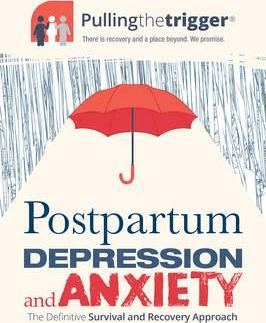
    Youngest was given the all clear aged one but it had taken its toll on Joel and I. I developed postnatal depression and severe panic attacks. I asked for help and went to counselling. Since then we’ve valued and always worked on our mental health.  Read this easy to use self help book about postnatal depression. 

    Postpartum Depression and Anxiety : The Definitive Survival and Recovery Approach

    Postpartum Depression and Anxiety : The Definitive Survival and Recovery Approach

    The Day My Physical Health Changed

    One day in 2009, aged 32, I woke with a sudden sharp pain around and behind my right eye. Standard painkillers didn’t help the pain, which was so severe I cried with every movement. I was signed off work for two months whilst my GP tried to help me. 

    I was misdiagnosed with infections and 2 chronic pain conditions before I was finally diagnosed with atypical migraine. I was given strong, preventative medication which my body took months to get used to. I had a phased return to my part time hours.

    Although the medication worked I still had low level constant pain, affecting family life and interfering with weekend plans. So I explored alternative therapies until I found a cranial osteopath who helped me live less painfully and our family more happily. 

    We could travel again and had many family adventures. The best thing was not being sensitive to sound so I could go to gigs, swim and watch the boy’s school shows. I aimed high and was promoted to an Early Years specialist and Senior teacher.

    Becoming A Chronic Pain Sufferer

    I started having migraine attacks every weekend. Then in January 2014 I had an attack that wouldn’t ease so my GP did an urgent referral to a neurologist who said my migraine had become chronic. Sadly that pain’s still with me years later. 

    I tried to push on but it was unbearable, I took sick leave, thinking I’d find a solution with traditional medication and natural therapies. Over the next 8 months I tried every migraine medication, elimination diets, reiki, reflexology and more but nothing helped.

    I couldn’t teach and began worrying about the future for myself and my family. I kept fighting it but the neurology team didn’t seem to care. I’d be upset on the phone to the nurse due to unbearable pain and she’d tell me to talk to my GP about ‘my mood’. 

    My tears fell from frustration of being unheard and the unrelenting pain that seemed different to the migraines I knew. So I researched constant headaches and a new symptom jumped out at me; the ‘whooshing’ in my ears was pulsatile tinnitus (PT).

    This was the first piece of the puzzle so I joined an online support group. I heard of a PT specialist in Cambridge and boy was that long car journey to see him worth it. He took my situation seriously and suspected Idiopathic Intracranial Hypertension or IIH

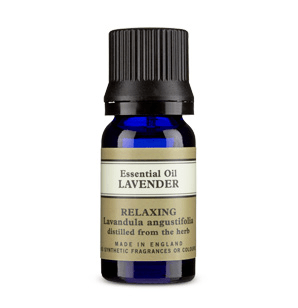
    I had to wait for the tests to confirm this and was told this would be a long process. I was on the migraine medication Merry Go Round, spending months weaning myself on and off of high doses of preventative medicine. Nothing improved my symptoms, although I got a little relief from using aromatherapy oils, especially this Neals Yard Lavender Essential Oil.

    My neurologist found out that I’d sought this second opinion and he refused to treat me. I knew I still had migraine so I was devastated. As the months went on, the ‘long process’ felt like forever. The pain lay heavy on me so I became severely depressed.

    I was losing my sense of self and felt left to rot. My GP was concerned so ran blood tests which showed I’d also developed Hypothyroidism. This explained the amplified feelings of hopelessness. My life became a chronic pain conditions balancing act.

    Idiopathic Intracranial Hypertension IIH Donate.jpeg

    Donate To IIH UK

    Improve the lives of sufferers

    What is IIH And Could I Have It? 

    IIH is associated with raised fluid pressure around the brain. The fluid that cushions the brain is called cerebrospinal fluid (CSF). It can cause disabling daily headaches and visual loss, which can be permanent.

    — iihuk.org.uk

    I started researching the symptoms of IIH, although I knew I didn’t have eye (optic) nerve swelling, called papilloedema. I was convinced I had it despite the headache specialist I saw shutting down my questions about IIH, as I didn’t have papilloedema. 

    IIH without Papilloedema (IIHWOP), is a very rare type of IIH. Less is known about it and many Doctors deny it exists. But the Cambridge team were working with other patients with similar symptoms to me so sticking with them was the best decision. 

    To be diagnosed with IIHWOP you need brain scans and a lumbar puncture (LP). Your explanation about the details of your symptoms is vital so I needed to document my experiences so I could give the specialists a clear picture of what was happening. 

    IIHWOP affects people differently so someone may have some or all of these most common symptoms. They may have additional symptoms too but all impact your quality of life. These are the most reported symptoms – read more about this here.

    • Headaches

    • Pulsatile tinnitus (PT)

    • Visual obscurations – temporary black outs or grey outs

    • Blurred or double vision 

    • Photopsias – short term flashes of light

    I still suffer with the same symptoms I had originally although the intensity changes. As well as PT, I have constant pain in my head, neck and around my right eye. I get very nauseous and have poor mobility; I can get dizzy, black out and stumble or fall. 

    I also suffer with brain fog, a type of cognitive dysfunction involving memory problems, lack of mental clarity and an inability to focus. This is linked to all of the chronic pain conditions I have but it has  improved with each surgery I’ve had for IIH. 

    IIH has left me disabled and bed-bound most of the time. I used to feel guilty about how this limits what I do but now I live day by day, saving my energy for family and friends. My family is about living a happy life, full of laughter and making memories.

    The Challenge To Get Treatment 

    My CT scans showed narrowing of blood vessels in the transverse sinus. This is part of the system acting as a conduit for the blood needed to oxygenate the brain. Watch how blood should drain into the dural sinuses through the internal jugular vein.

    This means I have restricted venous outflow so fluid builds up in my skull, causing a pressure cooker feeling. Headaches are a symptom of all my chronic pain conditions, so I’ve documented how they affect me to help me get the treatment I need. 

    However, getting the treatment for such a rare disease isn’t easy. Nothing was worse than a trip to A&E in late 2014 at the end of an intense weekend after I’d blacked out for the first time. When I finally saw a doctor she would only give me paracetamol! 

    My pain levels were so high, I was shaking as my legs felt like jelly.My GP prescribed a cocktail of pain relief, including oramorph, the following day. Of all my chronic pain conditions, IIH was the hardest to control, often leaving me I able to do anything. 

    This was a new level so Joel pushed for Cambridge to do the diagnostic tests. I was officially diagnosed with IIHWOP after the consultant listened carefully to how well the LP had temporarily reduced my pain levels, despite my LP result being low.

    My treatment plan, however, was delayed for over a year as their trial was under review. In 2017 I had my first of six surgical treatments. I’ve had skull and spine surgeries to create room for my veins and brain stents to reduce CSF build up. 

    The Truth About Living With Chronic Illness.jpeg

    The Truth About Living With Chronic Illness

    The truth is that living with chronic pain conditions tests your limits. We knew it would be a marathon, not a 10k race but I’ve had to accept that I need walkers, a stairlift, a wheelchair, and my gig ear plugs, to make it possible for me to go out on better days. 

    Joel’s my main carer and my boys are young carers for me. I also have a PA here each weekday lunchtime who is like a family member now. She ensures I eat and wash. She cooks, does laundry, keeps things tidy and is perfect company for me.

    Joel, myself and the boys have had to adjust how we live day to day with chronic illness in the mix. But by learning how to communicate effectively we’ve developed a stronger bond. The boys have become independent and resilient. 

    This is key to being able to thrive despite challenges. We work as a team to develop and encourage personal growth. My teaching skills have helped me facilitate finding solutions by making time to reflect on life whilst being mindful. 

    Joel’s always been more spontaneous than me so I’ve learnt how to make the best of my good days. I still love seeing friends or going out to eat but I have to be aware that all activity has consequences with high pain and sleep disturbances afterwards.

    We’ve created new routines to make the most of the time we have. We plan time together, such as family get-togethers and date nights. The boys tell me about their day and Joel and I make time to talk about how we’re feeling. This pays off long term.

    I know I’m so lucky to have Joel guide and stand by me through the toughest times and enjoy the good when we can. Chronic pain conditions impact your relationships so you have to make time for each other and find ways to release the stress. 

    The Chronic Pain Conditions Lifestyle Lowdown 

    Life can change overnight when you develop chronic pain conditions or mental health problems. When that involves family, your relationships change too. My story shows this and how we’ve succeeded by mixing plans with a day by day attitude. 

    Some people are diagnosed quickly with fairly common conditions, some spend years searching for a diagnosis. Wherever you are on your journey, it’s vital to learn about your condition and its symptoms so you make informed choices for treatment. 

    Any diagnosis leads to questions and concerns about the future. I believe that this is when you need a sense of purpose, especially when facing big changes and decisions. This is why I began blogging about my journey to raise awareness. 

    I’ve worked hard on my well-being to cope with the depression and pain that can hold me back. I refuse to let it win so I use distraction tactics. I am creative, I meditate and try to put myself first. Read about how I prioritise my wellness needs here.

    My husband struggled with his mental health and as our boys were young we chose to do family therapy. Thankfully my husband and children supported me in the good, bad and horrendous times. We built strategies to build good mental health for us all.

    Developing routines and structure leads to healthy communication which has made our family an awesome team. With their support I’m now emerging strong with hope and determination to get through hard times and enjoy the good.

    Stay safe
    L 💜

    P.S I can help you create better wellbeing strategies for living with chronic pain conditions. Download my free well-being planner here to prioritise your needs. If you want to get on a waiting list for updates on my first ever well-being product, please sign up to my newsletter below.


    ✋ Hey there! I hope you’re feeling stronger now. If so, sharing the love will help me help other mums with chronic invisible illnesses.⬇  Hit one of those sharing buttons or save the images to Pinterest and I will do a bed-bound happy dance – there’s an image for you!

    #block-yui_3_17_2_1_1599483536273_21920 .sqs-gallery-block-grid .sqs-gallery-design-grid { margin-right: -20px; }
    #block-yui_3_17_2_1_1599483536273_21920 .sqs-gallery-block-grid .sqs-gallery-design-grid-slide .margin-wrapper { margin-right: 20px; margin-bottom: 20px; }